Despite the fact that “cap room” was the major theme for the Rockets Thursday night, they still grabbed three players in the 2014 NBA Draft, selecting Swiss big man prospect Clint Capela with the 25th pick, Arizona guard Nick Johnson with the 42nd pick and adding the 53rd pick from Minnesota (for cash) to select Alessandro Gentile, a 22-year old scoring guard/forward out of Italy.
We got the chance to talk with Capela, Johnson and Rockets general manager Daryl Morey after last night’s draft. Here are the interviews:
Armed with a bizarre fascination for Mario Elie and a deep love of the Houston Rockets, Dave Hardisty started ClutchFans in 1996 under the pen name “Clutch”.
The Houston Rockets are unveiling a bold new look for the franchise, one which honors the past while attempting to push Rockets basketball into an exciting next chapter.
“Rooted in the energy, pride, and championship spirit of Houston, the new brand identity brings back the iconic ketchup-and-mustard color palette that helped define Rockets basketball for decades,” the team writes in its press release.
Yet, along with the ketchup-and-mustard scheme is a modern collection of logos, uniforms, and apparel designed for the future.
“We heard our fans,” said Patrick Fertitta, vice chairman of the Houston Rockets and Comets. “Ketchup and mustard is back! From the time my family bought the team in 2017, we’ve heard from countless fans about how deeply those colors are tied to their memories. We wanted to create something that celebrates the generations of fans who built Rockets basketball while inspiring the next generation of fans.”
Red returns as the heartbeat of the franchise, according to the team, while “championship yellow” is an effort to reconnect past greatness to the future ahead.
The “R” logo remains at the center of the new look and reinforces the organization’s core identity. Meanwhile, the reimagined “Dunkstronaut” blends nostalgia with innovation and further connects the franchise to the spirit of “Space City.” The new global logo draws inspiration from NASA mission patches, with two quasars symbolizing the franchise’s journey from San Diego to Houston.
Houston’s Icon (red) and Association (white) uniforms for the 2026-27 season reimagine the franchise’s visual identity while honoring the eras that shaped Rockets basketball. The Icon Edition features “Rockets” across the chest, while the Association Edition showcases “Houston” as a tribute to the city.
Both uniforms are accented with broken tonal pinstripes inspired by the team’s look from the mid-1990s and early 2000s. Custom typography derived from the championship-era wordmarks, including the return of the signature lowercase “t” and a distinctive slanted presentation, completes a uniform system rooted in legacy and built for the future, according to the team.
The Statement jersey embraces Houston’s “Space City” identity and the relentless pursuit of innovation. Its black base symbolizes the vastness of space, while a quasar-inspired pinstripe reflects the team’s speed, force, and intensity.
Along the side panels, rockets rise seamlessly from the shorts into the jersey, thereby creating a continuous visual expression of momentum and acceleration. On the jersey’s back middle portion, a red commander’s stripe draws inspiration from NASA mission leadership identifiers.
Each jersey includes a “Clutch City” jock tag framed by two quasars. The shorts prominently feature the “R” logo, while the Dunkstronaut logo appears on the waistband.
Fans can purchase the new apparel at RocketsShop.com and sign up for a mailing list to be notified when jerseys are available for purchase.
To celebrate the launch, the Rockets are hosting a special retail pop-up event at Houston’s George R. Brown Convention Center. The pop-up event will take place outside of Hall D on Friday, June 5, from 10 a.m. to 8 p.m. local time.
The first 100 fans that spend $100 or more will receive a free T-shirt. Former Rockets Rudy Tomjanovich (noon-1 p.m.), Steve Francis (2-3 p.m.), and Vernon Maxwell (4-5 p.m.) will each hold a signing session. Fans can also enjoy a live DJ alongside an interactive photo booth, games, and complimentary food and beverage samplings.
Among numerous decisions the Houston Rockets will face this summer, Tari Eason’s potential stint in restricted free agency looms as a vital one.
Last offseason, the Rockets initiated extension talks with Eason in hopes of reaching agreement on a long-term deal. But that hope apparently dwindled after ESPN’s Brian Windhorst reported that Eason declined a deal in excess of $100 million.
No further information on the length or amount guaranteed was detailed, but the verdict forced Eason to play out the 2025-26 season on an expiring contract. The contributions of his athleticism, shooting, and defense are highly valued and recognized by head coach Ime Udoka.
“He’s just a playmaker and disrupter,” Udoka said of Eason’s impact after a victorious Game 4 of Houston’s first-round playoff series against the Lakers. “Some of the natural instincts and things he does you can’t teach, you want guys to be sold and follow the game plan and all that, but some guys do what they do.”
“You’re going to get burned every now and then, but more often than not, he’ll make the right play, get a deflection or steal. Tari being Tari, you’ve got to let him do what he does.”
Enjoyed this from Ime Udoka on “Tari being Tari.” Called him a playmaker and disruptor. More from Udoka on benefit of Eason, “going rogue.”
“Half the stuff is outside of the gameplan, he just kind of goes rogue at times, but you try to turn a blind eye to it a little bit, he's… pic.twitter.com/KwWECSMhAf
Though the initial attempt at an extension fell through, the Rockets and Eason will have another exclusive negotiating window once the 2026 NBA Finals conclude. Should that pass without a deal, Eason would enter restricted free agency, which gives the Rockets the chance to match any offer from outside teams.
Teams can begin negotiating offer sheets once the 2026-27 league year begins on June 30, and should Eason sign an agreement with another team, Houston would have a brief period (48 hours once the moratorium lifts on July 6) with an opportunity to match. With both sides sharing interest in an extension, that might limit Eason’s outside offers, since other teams might not want to waste time.
Any external team attempting to sign Eason would have a “cap hold” that immediately places the salary figure used in the offer on hold, thereby limiting their resources to recruit other free agents during that period.
From Eason’s perspective, his choice to decline an extension last offseason placed added pressure on his play in the 2025-26 season.
The 6-foot-8 forward fnished the season averaging 10.5 points, 6.3 rebounds, and 1.5 assists while shooting 41.6% from the field and 35.8% from 3-point range. While his defense continued to excel, his shooting was inconsistent, as evidenced by making only 21.8% of his 3-pointers after the All-Star break. Inside the arc, his 41.6% clip was a career low.
Another concern with Eason, 25, is his health. The 60 games he appeared in this season were the most since his rookie campaign, when he played in all 82 games.
Evaluations of Eason seem likely to focus on the season’s final two months, with a goal of deciphering whether that stretch was simply a normal slump or an indictment on his game.
With his free agency approaching, Eason has expressed a desire to remain with the Rockets.
“It’s tough to say I didn’t think about it, you definitely think about it,” Eason said after the first-round series loss to Los Angeles. “I was drafted here, I’ve grown up here, my family is here, I love Houston. As far as everything else, God knows.”
Rockets forward Tari Eason was asked about free agency: “It’s tough to say I didn’t think about it. You definitely think about it. I was drafted here. I’ve grown up here. My family is here. I love Houston. As far as everything else, God knows.” #Rockets#Sarge@TheRocketsWirepic.twitter.com/jATvwZ8NIb
— BIG SARGE MEDIA LLC (@BigSargeSportz) May 2, 2026
While general manager Rafael Stone did not comment during exit interviews on potential extensions for Eason and Amen Thompson, he did say that he “fully expects they will be with us for the foreseeable future.” Entering June, reports have yet to link Eason to rival suitors, but that could change swiftly.
It will be intriguing to monitor if, in fact, the $100-million mark — even if not fully guaranteed — is still on the table following a year in which Eason’s play declined in a few areas.
With Fred VanVleet expected to make a healthy return, Eason projects to be a key reserve on the 2026-27 Rockets. As things stand, Houston’s current starters appear likely to be VanVleet, Amen Thompson, Kevin Durant, Jabari Smith Jr., and Alperen Sengun, with Eason, Reed Sheppard, and Steven Adams in line for prominent reserve roles.
As of now, the Houston Rockets do not own a first-round pick in the much anticipated 2026 NBA Draft. That asset was sent to the Oklahoma City Thunder as part of the ill-fated 2019 trade involving Chris Paul and Russell Westbrook.
If Houston decides against pursuing a veteran star this offseason — such as Milwaukee Bucks forward Giannis Antetokounmpo — the draft could play an important role for general manager Rafael Stone in identifying players who might address areas where improvement is needed.
And given the extremely deep talent pool, according to draft experts, moving up should at least be a consideration for the Rockets.
One asset that could help Houston climb the 2026 draft board is its collection of future picks, including unprotected first-round assets in 2027 from the Phoenix Suns and Brooklyn Nets (swap right). Both teams have uncertain-at-best outlooks for next season, which could make those potential lottery selections.
While landing a very high pick in 2027 or later could be quite valuable, there is also a path where using a future asset to trade up in this year’s draft might make sense.
New Draft Rules
With strategic tanking continuing to be a league-wide discussion and teams increasingly penalized for obvious attempts to lose games, the NBA appears poised to make additional adjustments to its lottery structure.
The proposed “3-2-1 system” would distribute lottery odds differently and reduce the advantages currently held by the league’s worst teams (by record).
For example, Brooklyn finished with the league’s third-worst record this season, and that guaranteed a selection at No. 6 or higher in the first round. But under a system designed to flatten lottery odds, possessing a similar record would no longer guarantee a premium pick.
Many league executives believe this year’s draft class has the potential to become one of the strongest in recent years. Next year’s class, however, may not carry the same expectations. With the depth available in 2026, first-round selections are perhaps much more valuable.
Who Might Houston Target?
Floor spacing, ball handling, and defense were among the traits Stone emphasized when discussing the types of players that Houston could target. Based on those priorities and the current identity of Houston’s roster, a few prospects stand out.
These players are generally viewed as mid-to-late selections in the first round, which could make a pick in that range more attainable by trade. For example, the Thunder and San Antonio Spurs own the No. 17 and No. 20 picks, yet both teams may not have available playing time to develop a 2026-27 rookie.
That could incentivize one or both teams to trade that pick elsewhere for a future asset. With that in mind, here are three potential options in that range.
Cameron Carr, Baylor
If the Rockets want to take a major swing, Cameron Carr could be an ideal fit. At 6-foot-5 with a 7-foot-plus wingspan, Carr averaged 18.9 points per game during his lone season at Baylor while shooting nearly 49% from the field and 37% on 3-pointers.
Along with his athleticism and ability to finish at the rim, Carr’s biggest value for the Rockets would be his shooting, particularly from long range. In Baylor’s game against the University of Houston that I attended, Carr notably knocked down multiple shots from well beyond 30 feet, and none came as desperation attempts late in the shot clock.
His shot creation and playmaking do not immediately stand out as elite traits, but they are more than sufficient for what the Rockets currently need.
Isaiah Evans, Duke
Unlike Carr, Isaiah Evans specializes more as a shot creator.
The 6-foot-6 Duke guard made significant strides during his sophomore season — in which he more than doubled his scoring average — after having taken a secondary role behind Cooper Flagg and Kon Knueppel as a freshman.
Evans’ 47% mark on pull-up jumpers stands out as an area Houston could benefit from. The Rockets need players capable of creating offense independently, rather than relying on teammates to generate those opportunities.
Fred VanVleet’s absence exposed some of those weaknesses, as Houston’s offense became heavily dependent on Kevin Durant — one of the few players on the roster capable of consistently creating his own shot.
From a Rockets perspective, Evans could fit naturally into that system and provide another perimeter threat alongside Durant and VanVleet.
Dailyn Swain, Texas
Dailyn Swain may be the most intriguing prospect among the group.
Although his 3-point shooting was a modest 34% last season, the 6-foot-8, 220-pound forward is extremely difficult to stop once attacking the basket. He already projects as a three-level scorer, as he possesses guard-like ball-handling ability and thrives in one-on-one situations.
His outside shooting percentages are not particularly concerning because of the steady progression he has shown throughout his career. After going 15% as a freshman, Swain bumped that to 25% as a sophomore and 34% as a junior.
That progression suggests a player committed to improving weaknesses, something not every young prospect embraces. With Stone repeatedly emphasizing “internal growth” as a major offseason priority, that type of work ethic would likely be highly valued by the Rockets.
Among the players listed, Swain may possess the highest long-term upside because of his physical tools and developmental potential.
When to Watch
The 2026 NBA Draft will take place over two days, June 23-24, in Brooklyn, New York. As things stand, the Rockets own picks at No. 39 and No. 53, overall, in Wednesday’s second round.
Each round will take place on its own day, with broadcast details and other logistics information available at NBA.com.
This is exactly what I do if I am the #Rockets. Keep drafting and developing. Don't fast track. Take a strategic step back. Trade for more draft picks and develop for the long haul. https://t.co/7a25EosVzd
On Wednesday, The Athletic released its annual anonymous poll of NBA players, who are asked to vote on various league superlatives.
Adding salt to the wound of the Rockets’ underwhelming 2025-26 season — which ended in a second consecutive first-round exit from the playoffs — Alperen Sengun topped the “most overrated” list with 12.3% of the vote.
The article then quoted a current NBA player who took a jab at the two-time All-Star, saying he’s “crying every play. He’s talented, but, dude, just play hard.”
Despite the relatively small sample size — 10 of 81 total votes — seeing a franchise cornerstone leading the list raises a larger question at hand: Which player from Houston’s so-called “young core” can truly emerge as a superstar?
The Athletic did their annual anonymous poll of NBA players and Alperen Sengun was voted the most overrated player in the league.
The recent playoff series versus the Los Angeles Lakers presented an opportunity for the Rockets to capitalize on their rebuilding years by having their highly drafted young players win a playoff series without Kevin Durant. On paper, that seemed to be a realistic possibility given the Lakers’ own injuries (Luka Doncic and Austin Reaves), but it never materialized.
When rebuilding, the Rockets had first-round picks in four straight drafts, selecting Jalen Green (No. 2 overall) and Alperen Sengun (No. 16) in 2021; Jabari Smith Jr. (No. 3) and Tari Eason (No. 17) in 2022; Amen Thompson (No. 4) in 2023; and Reed Sheppard (No. 3) in 2024.
Teams drafting in the lottery are typically searching for a franchise-altering talent, i.e. a player capable of becoming a foundational piece for a championship contender. While many of the Rockets’ young players have developed well, uncertainty still surrounds which of them — if any — can ultimately ascend into true superstardom.
At the center of that discussion is upside versus limitation. The two players closest to becoming franchise cornerstones are Sengun and Thompson, but both still possess flaws that are more glaring than ever in conversations about elite status.
Sengun, the lone NBA All-Star on Houston’s roster outside of Durant, has earned the nickname “Baby Jokic” because of stylistic similarities to Nikola Jokic.
Comparisons between Sengun and the three-time league MVP may feel like hogwash, but they are not entirely unfounded. Both centers operate with guard-like skill sets and thrive around the free-throw-line extended area.
The major difference, however, is perimeter shooting. Jokic is a far more reliable shooter, hitting 36% of his career 3-point attempts. Sengun is at 28%. That limitation makes Sengun easier to defend, especially as his touch around the basket has regressed at times.
Sengun has yet to make the necessary offensive leap to become a legitimate top-tier option. The counterargument is that he has never played in an offensive system fully built around him, sharing responsibilities early in his career with Green and now with Durant.
Still, Durant played only one game in the first round against the Lakers. Despite running plays heavily through Sengun, the Rockets eclipsed 100 points just once in six games — an inexcusable outcome for a player expected to anchor the offense.
Amen Thompson is expected to sign a “lucrative” contract extension this summer that is potentially a five-year deal worth more than $250 million, per @sam_amick
As for Thompson, he is arguably the current roster’s most talented player while already establishing himself as the team’s best perimeter defender. Much of his game currently relies on rare athletic gifts possessed by only a small percentage of the league, largely due to his lack of floor spacing. While Thompson’s midrange jumper has improved, his 3-point shooting remains well below average, even on mostly wide-open attempts.
For perimeter players, shooting is one of the most essential skills in today’s NBA. Guards who cannot shoot often become difficult to keep on the floor consistently, and even elite athleticism has limitations. However, if Thompson — already capable of averaging 18 points per game through downhill attacks and transition scoring — develops a respectable outside jumper, he possesses legitimate All-NBA potential.
Sam Amick of The Athletic reports that Thompson could sign a five-year, $250-million contract extension this summer, which would be the maximum allowed while making him the highest-paid player on Houston’s roster. General manager Rafael Stone said during his exit interview that internal development remains the organization’s primary focus this offseason, and a contract of that magnitude naturally raises expectations for significant growth.
The door has not closed on either Sengun or Thompson reaching superstar status, but the pressure is beginning to intensify. Relying on a soon-to-be 38-year-old Durant, who has played nearly 20 NBA seasons, to remain the best player only makes the Rockets’ path toward championship contention more daunting.
Other Rockets receiving votes:
Amen Thompson got one vote for most overrated and finished 11th (2.6% of the vote) for best defensive player.
Ime Udoka received 2 votes for most impressive coach aside from your own.
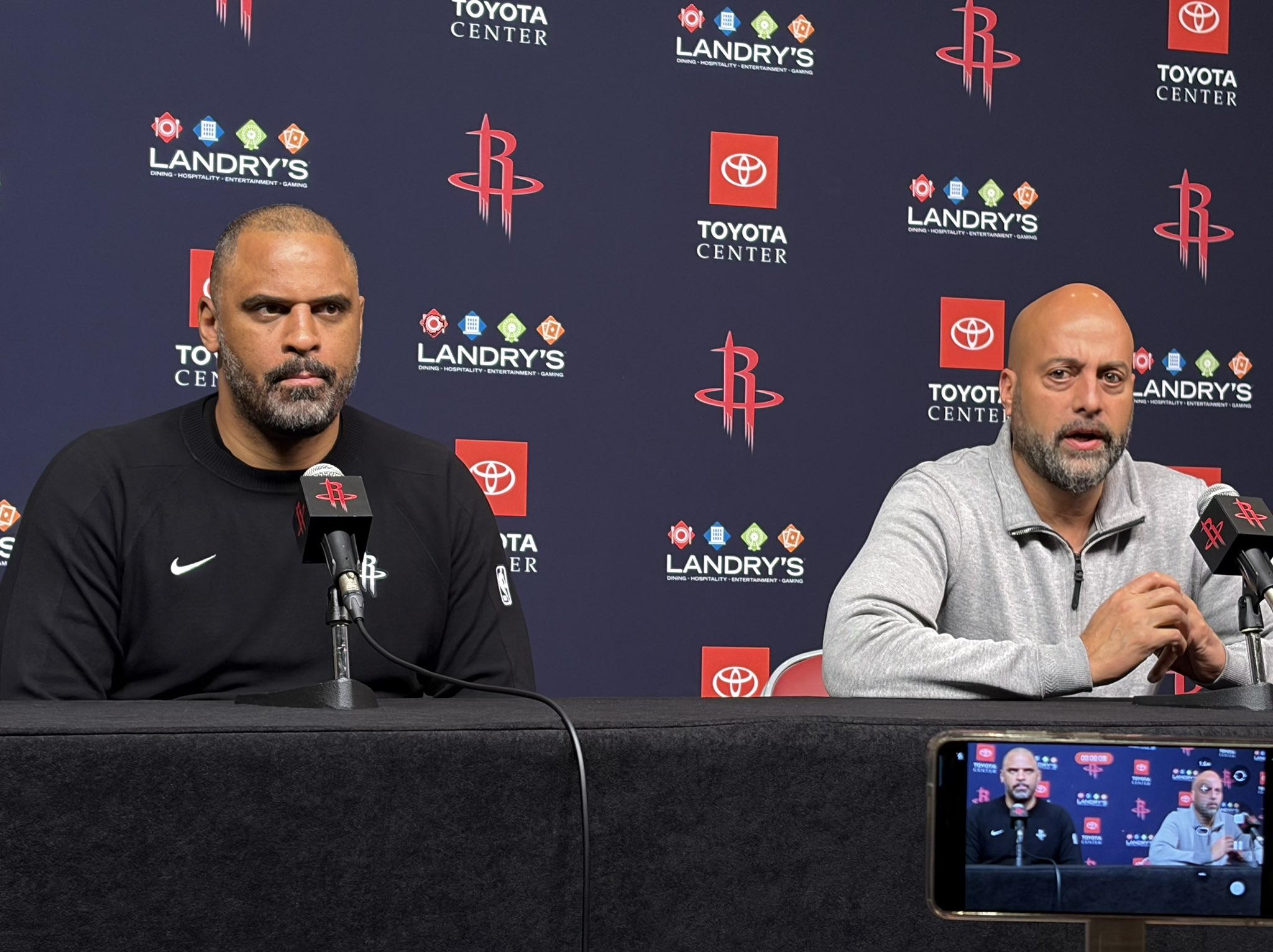
HOUSTON — With a pivotal offseason ahead, Rockets general manager Rafael Stone and head coach Ime Udoka met with local media members on Monday for their “exit interviews.”
There was much to address, considering how Houston’s 2025-26 season concluded in the first round of the playoffs and the team’s frustrating ups and downs throughout the year.
In fact, Stone didn’t sugar coat his assessment in delivering opening remarks.
“I think the season was frustrating and disappointing,” Stone told reporters at Toyota Center. “I understand that we took a lot of injuries this year and I do care about the injuries. But the expectation for winning is with the players we had playing.”
This offseason will be extremely important for the Rockets, and based on Monday’s responses, we may already have an idea of the approach they’ll take in improving the roster this summer.
Not Championship or Bust
Although Stone emphatically stated his expectation to win regardless of who is in uniform, the mindset of “boom or bust” doesn’t resonate as he oversees this franchise. A move such as trading for All-Star forward Kevin Durant in his 18th season might convey otherwise to some, but that wasn’t the message from team leadership.
“Not once did I ever say with respect to bringing Kevin in that it was championship or bust,” Stone said. “I never said that to him, I never said that to anybody, and that’s very much not our attitude. We thought he could a wonderful example to the young guys on how to work like a professional and how to really hone in on your craft. I thought he really did a good job of that.”
While the goal was certainly to win a championship, it appears that falling short won’t necessarily result in a revamp of the depth chart, even as Durant’s 38th birthday looms near the start of training camp (for the 2026-27 season) in late September.
Belief in Young Core
Amid chatter from fans and the mainstream media advising the Rockets to pursue a superstar, it seems Stone won’t be taking the bait.
On Monday, Udoka and Stone spoke frequently about internal growth from younger players like Tari Eason, Jabari Smith Jr., Reed Sheppard, and Amen Thompson, whom Stone specifically mentioned as guys he expects to be “way better basketball players” next year.
Two of those prospects, Thompson and Eason, are eligible for contract talks this offseason, and Eason is likely to enter the NBA’s restricted free agency market. While Stone has a policy not to comment on contractual matters, he did say that he’s “extremely high” on both players.
Stone’s belief in his group is part of the reason he didn’t acquire another guard during the season to help fill the void left by Fred VanVleet, Houston’s injured incumbent at point guard.
“What I don’t believe in, philosophically, is going out to get a point guard because they’re a point guard,” Stone explained. “Let’s just say someone is a good ball handler and passer, but they can’t defend and can’t shoot. Then, I’d rather just cobble it together.”
“My goal simply is to win, and the aesthetics just aren’t that important to me,” Stone continued. “Understanding the concern people have about the way things sometimes look, there are tradeoffs. Our team this year was very big and very physical. When Fred went down, I think we made a conscious effort just to lean in to that. I think it paid off, at times, and at times it hurt us. But again, it’s a tradeoff.”
What the Rockets Are Looking For
So, what do Udoka and Stone have in mind for roster moves? Versatility is a huge focus, as well as shooting. Specifically, they want the ability to be multidimensional with lineups while still adhering to the team’s overall identity.
“Variety is good for us, and shooting always stands out,” Udoka told reporters. “We want our guys to have internal growth in those areas. … I said in the final press conference (after losing Game 6 to the Los Angeles Lakers) where we have some guys that do a lot of the same thing. So, to have a little variety there — especially shooting — would be good.”
While adding shooting will be an offseason priority, it seems the Rockets aren’t willing to gut significant parts of their current roster to do so. In contrast to making major external acquisitions, it appears they would rather evaluate what a fully healthy roster can provide.
Time will reveal whether this strategy is successful. Houston will enter the 2026-27 season coming off consecutive years with 52-30 records and first-round playoff exits.
Rockets GM Rafael Stone on the approach this offseason, says getting healthy will be key, but also wants to see his young core get much better next season. @HoustonRockets#AllFirepic.twitter.com/6yVT3PgpvW