Connect with us
 

Houston Rockets

Jeremy Lin’s Big Test

Carl Fudge analyzes the strengths and weaknesses of Jeremy Lin and stresses the importance of the Rocket point guard getting out of the gate strong.

Published

on

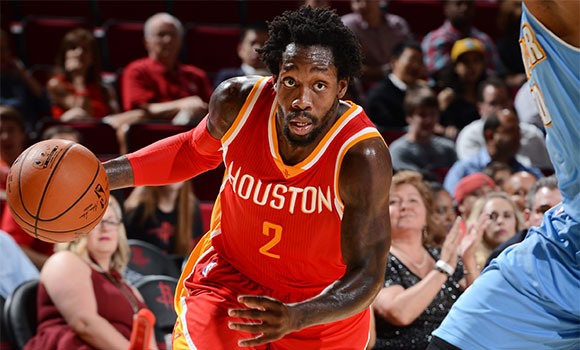
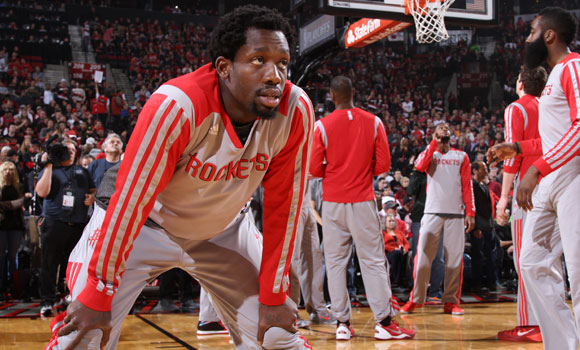
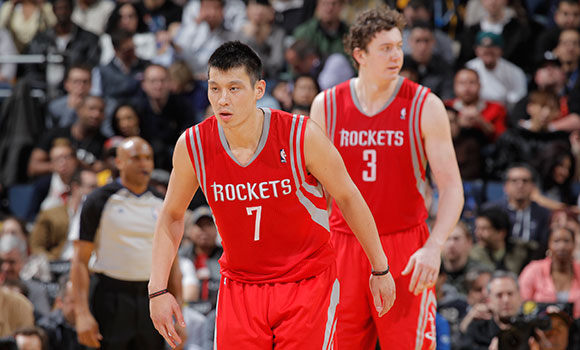
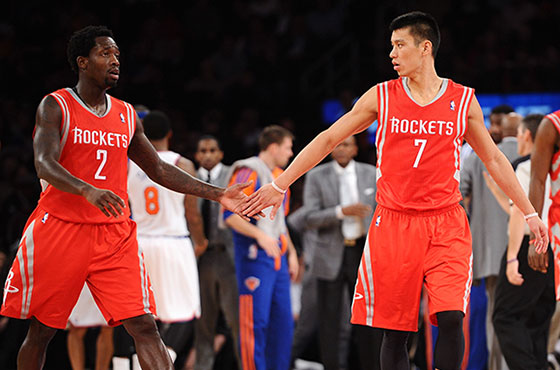
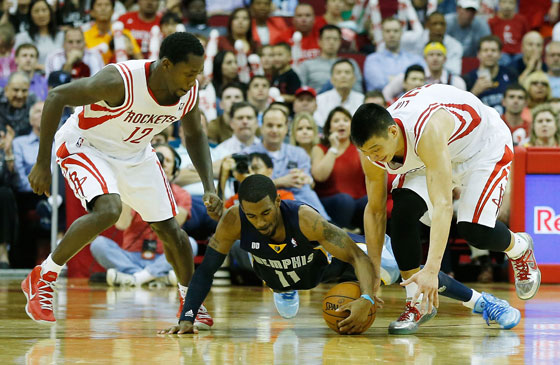
Jeremy Lin and Patrick Beverley

For the third straight year, Jeremy Lin comes into a Rockets training camp with a different role to play

Houston Rocket training camps have been interesting times for Jeremy Lin. Cut from the team two years ago, the 25-year old point guard returned to Houston last season as a flashy free agent acquisition following his unprecedentedly “Linsane” performances in New York. Houston general manager Daryl Morey prized the resurgent Harvard grad away from the Knicks with an infamous poison pill contract as Lin looked set to install himself as Houston’s point guard of the future, team leader and global icon that had been missing since Yao Ming retired.

How things have changed.

As training camp sets to kick off this weekend, Lin finds himself starting alongside All-Stars James Harden and Dwight Howard in a powerful lineup that has legitimate championship aspirations. While Lin was front and center of the team’s marketing efforts last season, this year he has seemed a secondary figure, hardly being featured in the team’s marketing campaigns and not called upon to help recruit Dwight. While Lin was the unquestioned choice as the team’s starting point guard last season, legitimate questions exist about his role on the team this year. Make no mistake, this is a pivotal time in Jeremy Lin’s career as a Rocket.

Just how good was Lin in 2012-2013?

No player in recent memory has sparked as much debate as the Rockets’ #7. Given the amount of attention and analysis he has generated since his Linsanity days, it can be hard to understand the real story and – to borrow a phrase from Nate Silver – separate the signal from the noise.

Let’s start with some of the things Lin did well.

Advertisement

2012-2013 was Jeremy Lin’s first full season as a Houston Rocket and as a starting point guard. He started every single game of the regular season, logging the third highest amount of minutes on the roster and guiding the team to a winning record and playoff berth.

Lin’s averages last year – 13.4 points, 3 rebounds and 6.1 assists – were solid but perhaps a bit underwhelming to fans who had hoped for Linsanity numbers and didn’t factor in his lower usage rate on the Rockets (20.7%) compared to his time on the Knicks (28%). While some fans questioned Lin’s performance, Morey clearly laid out why he was happy with his point guard’s debut season during an interview on CBS Sports Radio 610 back in May, saying:

Jeremy had a great year. The only way to think about Jeremy maybe not having a great year would be to say he had to play the whole year like he did in New York. James and Omer generated the most wins for our team but Jeremy Lin was third and on a 45-win team to make the playoffs and be the starter, he had a great season.

He’s the fifth-best pick and roll player in the league on nine pick and rolls a game. Overall, he really helped our offense, set up his teammates very well. On defense people focus a little bit too much on Tony Parker maybe did well against him, or some of these super fast guards, but the reality is those players do really well against everybody. On average, Jeremy had a very good defensive year, he’s very good at 50-50 balls, he’s very good at distributing the ball, and one of the top players in blocked shots and steals. So, overall, he had an extremely good year and we’re nowhere near the playoffs without Jeremy Lin.

Morey’s analysis, as always, is backed up by the numbers. Jeremy Lin was indeed the 5th best NBA pick-and-roll point guard in terms of points created for the roll man, setting up Rocket screeners nicely as they cut to the basket. This stat is even more impressive considering the somewhat limited offensive skillset of the recipient of most of those passes, Omer Asik. As I laid out in my last piece, the pick-and-roll is a fundamental part of the Rockets’ offense, and with Dwight Howard now on the floor, Lin and the Rockets will only become more dangerous in this facet of the game.

Lin was a good distributor of the ball in other parts of the offense last season too, dishing out 497 total assists (15th best in the NBA) at 6.1 assists per game (20th best). The majority of Lin’s assists led to dunks, close shots and three-pointers, showing both his ability to set teammates up for high quality shots that fit the game plan and his competence in running the fast break.

Advertisement

As a creator of his own offense, his performance dipped compared to his hot streak on the Knicks — Jeremy’s points per possession in isolations went down from 1.02 to 0.68. However, one thing that stood out was his ability to draw fouls while in the act of shooting. He finished 12th among point guards in And1% (And1s/FGA), and 17th in free throw rate (FTA/FGA), putting him above the likes of Kyrie Irving in both categories.

Lin was effective defensively too, and is probably a bit underrated in that part of the game. While he seemed to struggle staying in front of some of the quicker guards, Lin still contributed 1.6 steals per game (11th best among PGs in the NBA), 0.35 blocks per game (also 11th best), and took 0.27 charges per game (12th best among PGs). When you combine the previous 3 stats into a jumbo defensive rating, Lin was the 9th best defensive PG in the NBA.

Jeremy Lin's Strengths and Weaknesses

Taking a look at the strengths and weaknesses of Jeremy Lin

Three-point shooting, turnovers, mental toughness have been concerns

Despite Morey’s faith in Lin, critics do have a point to make. While the Rockets’ biggest positional disadvantage last year was power forward, the point guard position wasn’t far behind. Compared to their opponents, the Rockets had a PER (Player Efficiency Rating) deficit of 2.1 every night at the point guard spot, scoring two less points, delivering one less assist and committing one more personal foul.

One thing that has rightly caused concern among Rockets fans is Lin’s shooting percentages. The Rockets’ uptempo offense is designed to create a lot of open three-point shots, especially from the wings; last year the team took 2,371 shots from beyond the arc and made 867, the second highest total in NBA history by a team in one season. Three-pointers will be even more key this year with Howard and Harden certain to attract their fair share of double teams, leading to open shots on the perimeter.

Last year Lin took 257 three-pointers – over 10% of the team’s shots from that distance – and made 87 of them, good for a 33.9% average. That level of efficiency puts Lin outside the top 100 best three-point shooters in the league and well below the better three-point shooting point guards in the NBA, such as Jose Calderon (46.1%), Steve Nash (43.8%), Mario Chalmers (40.9%), Jarrett Jack (40.4%), and Irving (39.1%).

Advertisement

There’s no disguising Lin’s shooting numbers, but glimmers of light do exist. Lin shot about 5% higher from three-point land at home than he did away. His numbers from downtown (39.3%) in the final 34 games of the regular season were much better than his early season efficiency. And lastly, his most effective shots came from spot-ups, exactly the shots he’ll see more of with Dwight on the floor. With more experience in the league’s different arenas, less defensive attention on him and lots of offseason practice, it is fair to expect him to convert his treys this season at a much higher clip.

Turnovers were also a concern. His assist-to-turnover rate was a Jrue Holiday-esque 2.13, putting him outside the top 30 PGs in the league. Adding to that was his turnover ratio (% of possessions that resulted in a turnover), which at 13.3% was the fourth highest in the league. Lin’s turnovers were caused more by bad passing (131) than by bad ball handling (89) and that number probably suffers a bit due to the fast pace the Rockets employ. With that said, Lin coughed up the ball as much in pick-and-roll situations (20.9% of these possessions led to a turnover) as he did in transition (21.1% of his transitions led to a turnover), suggesting a need for better decision making with the ball and playing more under control.

A final concern exists around Lin’s mental makeup. By his own admission, he struggled with this facet of his game last year. Describing the challenges he faced last season as a Rocket and his mentality moving forward, Lin said:

“I’m just going out there to play and not worry about anything: about proving myself to anybody, or proving my worth, or trying to live up to a contract, or whatever. I’m just going to go out there and play completely free of all the expectations and all the noise, the pressure. With the signing of Dwight and the emergence of James, there’s going to be a lot more spotlight, but for me it’s just a matter of going in everyday and doing my best. I’m just going to play the way that got me here.”

Will below average be good enough?

Advertisement

While there is no glaring hole in Lin’s game, he also doesn’t have an elite skill either. He’s an above average passer and defender that runs the pick-and-roll well, but he’s a below average shooter, ball handler and creator of his own offense. When you add it all up and stack him up against a league that’s full of quality point guards, you get a player whose PER output (14.9) is below average for his position (16.2) and puts him just outside the league’s top 30 playmakers. While the PER stat isn’t loved by all, other advanced stats tell a similar story: he didn’t make the top 15 of a recent WARP-based projection of the NBA’s top point guards and he ranks 27th among point guards in both Value Added and Estimated Wins Added. Championship-winning teams do not have to be elite at every position, but with only two All-Stars, the Rockets need to squeeze every drop of performance out of their point guard spot if they are serious about contention.

What could happen if Lin has a slow start

Lin is the clear starter, but if he returns to his past struggles from the three-point line, commits too many turnovers or fails to gel with Dwight, it could lead to him being replaced in the starting lineup in favor of Patrick Beverley, who played well last year as Lin’s backup. Though Beverley’s minutes constitute a smaller sample size (710 minutes), the Rockets as a team posted a 98.8 Defensive Rating when he was on the floor (compared to 104.0 with Lin), a ranking that would be good enough to be third best defense in the league. To add to that, there was almost no dip offensively (106.4 Offensive Rating with Lin on the floor, 106.1 with Beverley).

While it is not plan “A”, it is possible that the Rockets could be more dangerous with Lin on the bench than when he starts. In Asik and Lin, the Rockets could deploy two starting-quality players against other teams’ second string lineups, a configuration that would allow Lin to be a #1 offensive option. Lin has played well in that role in the past with the Knicks in 2011-2012 and in bursts last year, with his breakout 38-point night coming against the Spurs when Harden was out with an injury.

The Rockets won’t rush any decision. They understand the value of lineup stability and will want to collect a reasonable sample size of data to analyze both his and Beverley’s play before deciding that a change is needed. Suggestions in the recent ESPN Insider piece that Coach McHale might change his lineup based on training camp and preseason were probably a bit aggressive. The theory I have heard from an NBA source is that the Rockets will give the new Dwight-led lineup 20 games to gel before making a move of this magnitude.

Advertisement

Of course, coming off the bench was not what Lin had in mind when he signed his $25M contract last year, but with Howard and Harden now in the fold, the bar of expectations has been raised and the need for the right fit has increased. If he takes a step forward and proves to have addressed some of his weaknesses, he can cement his role as the starting point guard on a contending team.

Now we see if he’s ready for that new challenge, because for the scholarly Lin, the first 20 games of the 2013-2014 NBA season will be the biggest exam he has ever taken.


Carl Fudge is a second year MBA at MIT Sloan where he is the content lead for the Sloan Sports Analytics Conference. He is a lifelong Rockets fan and has been posting on ClutchFans as GBRocket since 2003.


Advertisement

Analysis

With NBA Cup run complete, Rockets add Clippers, Nuggets to December schedule

Published

on

Photo via Houston Rockets, Rockets.com

After their Emirates NBA Cup 2025 elimination, the Rockets (12-4) learned two additional December dates for their 2025-26 regular season.

As announced Saturday by the league office, the Los Angeles Clippers (5-14) will visit Houston on Thursday, Dec. 11. Tipoff at Toyota Center will be at 7:00 p.m. Central.

Meanwhile, the Rockets (12-4) will then head to Denver on Monday, Dec. 15, where tipoff versus the Nuggets (13-5) is at 8:30 p.m. Central.

During Cup games, all three of the Clippers, Nuggets, and Rockets went 2-2 in Western Conference group-stage play. Because only four teams out of the 15 in each conference advance to the knockout rounds, a 2-2 record in group games isn’t usually enough to finish among the top four, and that was again the case this year.

Advertisement

To ensure that all teams play 82 regular-season games, teams who don’t advance then have two additional December games scheduled versus same-conference opponents who also did not advance.

In most cases, these add-on matchups come down to a formula. Taking Houston as an example, each season’s schedule includes two games (one home, one away) versus all East opponents and four games (two home, two away) versus most West opponents.

However, if that was the case for all same-conference opponents, the schedule would be at 86 games in length. So, there is a select group — rotating each year — of same-conference opponents on the docket only three times.

To trim down to 80 games (to account for the possibility of Cup advancement), the six West teams with only three dates on Houston’s initial 2025-26 schedule were the Clippers, Nuggets, Warriors, Oklahoma City Thunder, Minnesota Timberwolves, and Los Angeles Lakers.

Add-on games are typically chosen from that group, and the Thunder and Lakers advanced in Cup play, thus taking them off the table. So, it came down to two teams from the other four.

Advertisement

Led by James Harden, the reeling Clippers have yet to play Houston this season, though they will meet again on Dec. 23 in Los Angeles.

Meanwhile, the Nikola Jokic-led Nuggets enjoyed a close Nov. 21 victory in Houston. For the Rockets, Kevin Durant and Alperen Sengun each struggled in that game.

Now, less than a month later — in a matchup that could prove pivotal in the West standings race — Durant and Sengun (assuming health) will get an opportunity to make amends.

Denver and Houston are currently tied for the No. 3 spot in the West (trailing the Thunder and Lakers), though the Rockets are technically ahead by percentage points due to playing two fewer games. Thus, that Dec. 15 rematch could have significant stakes for both sides.

Advertisement
Continue Reading

Analysis

This Thanksgiving, the Rockets are thankful for Reed Sheppard

Published

on

Photo via Houston Rockets, Rockets.com

Relative to their expected formula from the 2025 offseason, the Rockets were missing five rotation players in Wednesday’s Thanksgiving Eve playoff rematch versus the Warriors.

Kevin Durant (personal reasons), Steven Adams (right ankle tendinopathy), and Tari Eason (right oblique strain) were all sidelined, and veterans Fred VanVleet (right knee) and Dorian Finney-Smith (left ankle) remain on the shelf after offseason surgeries.

Yet, the Rockets (12-4) still won for a 12th time in 14 games, and they overcame a 14-point road deficit against a high-profile Golden State squad featuring the likes of Steph Curry, Jimmy Butler, and Draymond Green.

The biggest reason was second-year guard Reed Sheppard, who set career-highs in points (31) and rebounds (9) while making 12-of-25 shots (48.0%), including four 3-pointers.

Advertisement

“He was big,” said head coach Ime Udoka, whose Rockets won despite shooting below 40% overall and 30% from 3-point range. “Reed really held us together when guys were struggling.”

For the season, Sheppard — a starter for Udoka over the past two games — is averaging 14.3 points, 3.3 assists, 2.8 rebounds, and 1.6 steals in 24.9 minutes per game. He’s shooting 48.8% overall and 45.5% on 3-pointers, with the latter figure coming in at No. 11 among hundreds of qualified NBA players.

But the advanced metrics are even more impressive. Per Basketball Reference, here’s where Sheppard ranks among his NBA peers in several impact categories:

• Box plus/minus (BPM): No. 5 (7.3)
• Defensive BPM: No. 6 (2.7)
• Offensive BPM: No. 15 (4.6)
• Win shares per 48 minutes: No. 10 (.208)
• Value over replacement player (VORP): No. 16 (0.9)
• True shooting (TS): No. 42 (62.9%)
• Player efficiency rating (PER): No. 40 (19.6)
• Steal percentage: No. 5 (3.3%)

Advertisement

The only players with a superior BPM are a quartet of annual Most Valuable Player (MVP) frontrunners in Nikola Jokic, Shai Gilgeous-Alexander, Giannis Antetokounmpo, and Luka Doncic. At the moment, Sheppard is the league’s highest-rated American player!

To say the least, those are remarkable efficiency metrics for a 21-year-old in his second NBA season. And it’s not as if Sheppard is posting those in low-leverage minutes, as evidenced by the key plays he made in the fourth quarter to help put the Warriors away.

“Defensively is where he’s shown the most improvement, overall,” Udoka said from San Francisco. “I think he’s taking on the challenge. The blow-bys are getting less and less. He’s catching up with the physicality of the game. Teams are going to try to attack him, at times, but like we said last year and during this summer, make them go east and west and stay in front of them. Help will come. He’s doing a great job of that.”

Sixteen games in, it’s no longer a particularly small sample. Rounding, it’s actually 20% of the 82-game regular season!

Advertisement

Assuming relative health, the 2025-26 Rockets had a high floor entering the season due to the All-Star presence of Durant and Alperen Sengun. But whether they could achieve a championship ceiling likely depended on further leaps from young players — most notably, the high-upside ones like Sheppard and Amen Thompson.

With Durant out, Thompson was the headliner in Monday’s road victory in Phoenix, and Sheppard stole the show two nights later at Golden State.

For everyone surrounding the organization, it’s an appropriate time to be thankful. With these leaps being shown from players who are extremely young and still improving, the Rockets appear set up to be a force in the Western Conference for quite some time.

“It’s going to be exciting when we get fully healthy and whole,” Udoka surmised.

Advertisement

Continue Reading

Analysis

2025 NBA Cup math, schedule update: Rockets unlikely to advance

Published

on

Photo via Houston Rockets, Rockets.com

Entering Thanksgiving week, all 30 teams have at least one of their four group-stage games remaining in Emirates NBA Cup 2025 action. Some have two.

But for the Houston Rockets (10-4 on the 2025-26 regular season, 1-2 in Cup play), elimination appears almost inevitable after Friday’s group-stage loss to the Denver Nuggets.

To explain why, let’s look at the Cup standings entering the week:

After their winning their group in the 2024 NBA Cup, the Rockets have already lost the possibility of doing so in 2025. Even if the Rockets win their group-stage finale at Golden State on Wednesday night, Houston’s best-case outcome is a 2-2 mark.

The only way 2-2 would be tied for the Group C lead is if Portland loses at home to San Antonio on Wednesday, followed by the Spurs winning at Denver two nights later. Without that combination of results, at least one of the Trail Blazers and Nuggets would have three group-stage wins, which inherently eliminates Houston.

But even if that unlikely 2-2 scenario somehow played out, the Rockets would be 1-2 against the other three teams in that 2-2 tie. The Spurs and Nuggets would each be 2-1, thus eliminating Houston as a potential group winner.

Advertisement

So, Group C is off the table.

Mathematically, the Rockets do remain alive for the wild-card slot, which goes to the top second-place finisher in each conference. For example, if this week’s games go according to the Vegas odds, it’s quite possible that the Spurs could defeat Portland but lose to Denver, creating a three-way tie between the Rockets, Trail Blazers, and Spurs at 2-2. Since each team would be 1-1 against the other two, head-to-head, it would come down to point differential — and Houston is well ahead of Portland (-18) and currently tied with San Antonio (+10) there.

Should Houston win that tiebreaker, the Rockets would finish second in in Group C. But looking at the remainder of the West, it’s unlikely for that to be enough to earn the wild card.

For starters, if any second-place team in Group A or Group B gets to three wins, the Rockets are automatically eliminated. Last season, both wild-card teams went 3-1 in group play.

But even if 2-2 somehow becomes enough for a tie, the point differential of the Minnesota Timberwolves (2-1, +53) and Oklahoma City Thunder (2-0, +63) will be difficult to overcome. At the moment, those teams — who play each other on Wednesday — are 43 and 53 points ahead of the Rockets, respectively.

Advertisement

So, in order for Houston’s 2-2 mark to somehow be enough to advance, the Rockets would need to make up at least 43 combined points between the final margin of their road game against the Warriors and the remaining group games for the Timberwolves and Thunder.

To say the least, that’s a tall order.

As a result, while not mathematically eliminated just yet, the odds are overwhelmingly against the Rockets advancing to the eight-team knockout phase.

There could, however, be some consolation. Should the Rockets improbably advance to the knockout rounds as a wild card, they would play on the road in the quarterfinal round. From there, should they win, their next game would be in Las Vegas for a neutral-site semifinal.

On the other hand, if the Rockets are eliminated, they would have two games added to their schedule versus West rivals who they are currently slated to play only three times (and not the usual four for most same-conference teams). These add-on games, which would be played during the week of Dec. 9-16, allow all teams to finish at 82 regular-season games in the final 2025-26 standings — i.e. the same as those who gain additional games from advancing to the knockout rounds. The Cup title game does not count toward regular-season standings.

Advertisement

For the Rockets, in contrast to the wild-card scenario, it’s worth noting that one of those two add-on games would be at home, inside Toyota Center.

The possible opponent pool consists of the Thunder, Warriors, Nuggets, Timberwolves, Los Angeles Lakers, and Los Angeles Clippers — and since these would be non-Cup matchups, it would have to be opponents who were also eliminated in group-stage play.

Breaking down that group of six, the home matchup would likely come against a team that is currently on the books for only one appearance in Houston this season. Based on the current schedule, that’s the Warriors, Nuggets, and Thunder.

Conversely, the other three teams — the Lakers, Clippers, and Timberwolves — are only scheduled to get one visit from Houston this season. So, those would likely be the three in the mix for Houston’s add-on road game.

Since the Warriors are almost certain to be eliminated after the Cup’s group stage — and the Nuggets and Thunder are likely to advance to the knockout rounds — the odds would suggest that Golden State becomes Houston’s additional home game in December.

Advertisement

For the add-on road game, the Timberwolves and the loser of Tuesday’s Lakers-Clippers Cup showdown — both Los Angeles teams are 2-0 in Group B, at the moment — would seem to be the strongest candidates.

So, relative to advancing in Cup play, being eliminated would give the Rockets one additional home game. Furthermore, if the add-on games become the Warriors and Clippers, both of those teams are currently at .500 or below this season. As a result, it’s probably to Houston’s scheduling interest for the Clippers to lose on Tuesday night, though it could be argued that the looming return of Kawhi Leonard makes them more of a threat.

Conversely, should Houston somehow advance, any knockout-round opponent would likely be a stronger team. After all, there’s probably a good reason why that team advanced.

It’s a small silver lining, but it’s not nothing. By not advancing in Cup play, the Rockets are likely to get one more home game at Toyota Center — and it’s likely to be a fun one versus Steph Curry, Draymond Green, and the hated Warriors.

For the Rockets and other teams across the league, those Dec. 9-16 matchups, dates, and times will be announced after the Nov. 28 conclusion of all group-stage games (schedule).

Advertisement

Continue Reading

Analysis

‘Fills this glaring void’: As Rockets stack wins, Kevin Durant draws national praise

Published

on

Photo via Houston Rockets, Rockets.com

After Sunday’s thrilling come-from-behind victory over Orlando (ClutchFans postgame show), the Houston Rockets have now won nine of their last 10 games, overall.

At 9-3, the Rockets are just a half-game back of Denver for the No. 2 spot in the Western Conference standings, and they still rank No. 1 in the NBA in offensive rating.

One clear reason for that success, both in Sunday’s comeback against the Magic and the 2025-26 season to date, is the offseason addition of All-Star forward Kevin Durant.

Now 37 years old, the future Hall of Famer is currently averaging 25.9 points and 4.7 rebounds per game while shooting 51.0% overall, 40.0% on 3-pointers, and 88.8% on free throws.

Advertisement

On ESPN’s latest The Hoop Collective podcast, Tim MacMahon and Tim Bontemps dove deeper into what it means for the Rockets as a team.

MacMahon: “Can we talk about the fact that KD is still an elite scorer in year 19? There’s been very little dropoff there, and now he’s in a situation in Houston where he just fills this glaring void as a go-to guy. He’s off to an incredible start.”

Bontemps: “Last season, the Rockets in offensive rating were 12th in the regular season. This year, they’re first. Yes, some other things changed. (Alperen) Sengun has played great, and Reed Sheppard is really starting to play well.”

“But Dillon Brooks is an inefficient shooter, and Jalen Green is a very inefficient shooter. They swapped them out for Kevin Durant, and that’s a pretty giant part of why they went from being an up-and-down offensive team — who really needed to offensive rebound to have any success — to now having the best offense in the league. They’re still offensive rebounding like crazy, but they also have Kevin Durant out there to make shots.”

MacMahon: “He’s averaging 26 (points) on 51-40-89 shooting splits. That’s pretty good.”

Advertisement

The complete podcast, which also features ESPN’s Brian Windhorst, can be viewed below.

Durant and the Rockets will look to keep their momentum rolling when they visit Donovan Mitchell’s Cleveland Cavaliers (10-5) on Wednesday night. Tipoff is at 6:00 p.m. Central, and the game will be televised to a national audience on ESPN.

Advertisement
Continue Reading

Analysis

After routing Portland, Rockets storm back into 2025 NBA Cup race

Published

on

Photo via Houston Rockets, Rockets.com

When Houston lost its Emirates NBA Cup 2025 opener by double digits in San Antonio, its odds of advancing to December’s eight-team knockout rounds appeared low.

But one week later, after Friday’s 24-point blowout of Portland (led by Kevin Durant, who scored 30 points and was +37 in his minutes), the Rockets are now in a much better spot.

Between Houston’s home win over the Trail Blazers and Golden State’s late-night victory at San Antonio, all five teams in Western Conference Group C are now 1-1 at the midway point of group play. Many observers around the NBA are calling that the “group of death” for the in-season tournament, referring to the collective difficulty of those teams.

As things stand, four of those five squads have winning records in the 2025-26 regular season, and the fifth (6-6 Portland) is at .500.

Advertisement

In Cup play, with all teams having split against each other, the second tiebreaker criteria (after head-to-head) is point differential. From that standpoint, the margin the Rockets were able to put up Friday was very helpful. Here’s how the five teams currently stack up:

1.) Denver: 1-1, +23
2.) Rockets: 1-1, +13
3.) San Antonio: 1-1, +10
4.) Portland: 1-1, -22
5.) Golden State: 1-1, -24

Houston’s final two NBA Cup group games are next Friday, Nov. 21, at home versus Denver, and then the following Wednesday, Nov. 26, at Golden State.

Advertisement

Neither game will be easy to win, but if the Rockets get to 3-1, they would have the head-to-head tiebreaker advantage over every team in the group outside of the Spurs.

In that scenario, the only way the Rockets could potentially not win the group is if the Spurs swept their road games at Portland (Nov. 26) and Denver (Nov. 28) over Thanksgiving week. The Spurs would likely be underdogs against the Nuggets, assuming Nikola Jokic is healthy and available to play.

And even if San Antonio did win both of those games, the Rockets could still have a realistic chance of securing the fourth and final Western Conference knockout-round slot via the wild card, which is determined by point differential. That’s where Friday’s blowout margin versus the Trail Blazers could pay even more dividends down the line. In each conference, the wild-card spot goes to a second-place finisher with the best point differential.

Those knockout round games — or add-on regular-season contests, in scenarios where the Rockets are eliminated early from NBA Cup contention — will be added to the schedule for the week of Dec. 9-16. Opponents, dates, times, and locations will be announced at the end of November, once all group-stage games are concluded.

Advertisement

Granted, the biggest priority for the Rockets remains the 2025-26 regular season and building up for an eventual run in the 2026 NBA playoffs. At the moment, the Rockets are 8-3 and have won eight of their last nine, overall. That’s the primary focus.

That hot stretch has lifted Houston to the No. 3 spot in the West standings, trailing only Oklahoma City (12-1) and Denver (9-2), and the Rockets will have a chance to gain a game on the Nuggets during next Friday’s showdown at Toyota Center.

Yet, it’s becoming clear that Houston cares about the NBA Cup, as well. In Friday’s game versus the Trail Blazers, All-Star center Alperen Sengun checked back into the game with just over five minutes left and the Rockets ahead by 26 points.

Sure, he might have wanted a triple-double. But from the perspective of head coach Ime Udoka, the most plausible explanation seems to be that he wanted to sustain that lofty margin, which the Rockets were largely able to do.

The bottom line is this: With two group-stage games left to play, the Rockets have suddenly found themselves in a solid position, from an NBA Cup perspective.

They don’t fully control their own destiny, of course. But if they are able to win against the Nuggets and Warriors, it now appears more likely than not that Houston would advance to the knockout rounds for a second consecutive year.

Advertisement

Relative to seven days ago, that’s a good place to be.

Continue Reading

Trending