Houston Rockets
Houston Rockets Salary Cap Update: 2012-13 Training Camp Edition
With the Houston Rockets opening training camp in advance of the 2012-13 NBA season, let’s take a look at the team’s current salary cap situation.

With the Houston Rockets opening training camp in advance of the 2012-13 NBA season, let’s take a look at the team’s current salary cap situation.
Delfino gives the Rockets another veteran presence on a very young roster.
The Rockets’ Latest Moves
Since my last update, the Rockets have made the following roster moves:
- The Rockets signed Carlos Delfino in mid-August to a two-year deal paying him $3 million next season with a non-guaranteed $3 million salary for the 2013-14 season.
- The Rockets waived Josh Harrellson (on August 15) and Sean Williams (on August 29), whose salaries would have become fully guaranteed had they not been waived at those times.
- On September 7, the team signed Scott Machado to a three-year deal for the league minimum salary, with the first year 50% guaranteed.
- The Rockets waived Diamon Simpson.
- On September 25, the team waived Courtney Fortson and signed guards Demetri McCamey and Kyle Fogg (presumably to non-guaranteed league minimum contracts).
The Trade That Wasn’t
Conspicuous by its absence from the list above is a major trade for You Know Who. For some reason, the ownership and top management of the Orlando Magic felt that Arron Afflalo was a future multiple-time All-Star and that Maurice Harkless (a player the Magic scouted heavily before the draft) was a top-10 talent from this year’s draft class. In their attempt to push the league’s best center out of the Eastern Conference (something that could have just as easily been accomplished by trading him to the Rockets), the Magic instead ushered the league’s second-best center into the Eastern Conference, allowing Andrew Bynum to go to the Sixers in the four-team monstrosity that most pundits claim benefited every team involved except the Magic.
Instead of the lottery-level draft picks, young talent and cap flexibility that the Rockets’ trade offer(s) could have provided the Magic, Orlando instead is left with some comparable young talent but also some bloated contracts (Afflalo and Al Harrington) and a plethora of future picks almost guaranteed to be at the back-end of the first round.
As a result of that trade, the Lakers are back to “top title contender” status and the Rockets are back to the drawing board.
Salary Commitments and Potential Cap Room
(DISCLAIMER: With 20 players currently on the roster, one can be assured that further roster moves will be made, since the regular season roster must contain no more than 15 players. The figures below do not represent the Rockets’ true cap situation once such additional moves are made; they are solely intended to give you a picture of the Rockets’ current cap situation. All salaries courtesy of ShamSports.com.)
Barring any further roster moves, the Houston Rockets now have approximately $55.58 million in team salary for the 2012-13 season: Kevin Martin ($12.44 million), Jeremy Lin ($8.37 million), Omer Asik ($8.37 million), Shaun Livingston ($3.5 million, only $1 million of which is guaranteed), Delfino ($3 million), Patrick Patterson ($2.10 million), Toney Douglas ($2.07 million), Jeremy Lamb ($2.02 million), Marcus Morris ($1.91 million), Royce White ($1.65 million), Gary Forbes ($1.5 million), Terrence Jones ($1.49 million), Donatas Motiejunas ($1.36 million), JuJuan Johnson ($1.09 million), Jon Brockman ($1 million), Chandler Parsons ($888,250), Greg Smith ($762,195, of which 50% is guaranteed), Machado ($473,604, of which 50% is guaranteed), McCamey ($473,604, non-guaranteed), Fogg ($473,604, non-guaranteed), and the cap hit from the Derek Fisher buyout ($644,005; more on that here).
[ShamSports.com shows that the Rockets also owe E’Twaun Moore $381,098 (50% of his 2012-13 salary), supposedly the product of a renegotiation of his contract with Boston prior to the Courtney Lee sign-and-trade deal in which the Rockets acquired him. However, according to a source familiar with the Rockets’ salary cap situation, the Rockets are not paying Moore; hence, I am disregarding this salary for purposes of my own cap calculations. Even if ShamSports.com is correct about Moore, though, the acquisition of the Charlotte Bobcats’ 2013 second round pick from Boston was well worth the small incremental loss of cap space.]
Based on this season’s maximum salary cap of $58.044 million, unless the Rockets make another trade or sign another free agent, they will have at least approximately $2.47 million in salary cap room entering the season (or about $2.09 million if they do, in fact, take a cap hit on Moore). This assumes that only players whose salaries are fully guaranteed are waived. That is a rather unsafe assumption, however.
[NOTE: Rather than make assumptions on what the Rockets’ cap situation will look like based on the numerous combinations of how the final roster will look, I will reserve any discussion on the Rockets’ available cap room for my next Salary Cap Update once the final regular season roster is set.]
Decisions, Decisions – Part 1: Who To Keep?
Of the 20 players under contract with the Rockets, 18 of them are owed at least some guaranteed money that would count against the cap if they were waived. Of those, 15 players have fully guaranteed contracts.
For a moment, let’s make the rather safe assumption that the Rockets will not be cutting any of their (or at least my) projected starting five (Lin, Martin, Parsons, Patterson and Asik), Delfino and their own 2011 and 2012 first round draft picks (Morris, Motiejunas, Lamb, White and Jones). That leaves nine players fighting for four regular season roster spots.
Of those nine remaining players, Douglas has the most guaranteed money owed and also plays some point guard, a position at which the Rockets are low on experience. Douglas also possesses two skills that the Rockets can really use: perimeter defense and (at least prior to his abysmal 2011-12 season) three-point shooting. Therefore, I think Douglas may be safe and could become a decent bench option as a combo guard and defensive upgrade over Lin and Martin (neither of whom should be getting any votes for the NBA All-Defense Team any time soon).
Forbes, Johnson and Brockman are all young forwards who have at least shown flashes of being able to play in the NBA (with Johnson being a 2011 first round pick by Boston). Each is owed at least $1 million guaranteed. While their games are all different (Forbes is a SF with a bit of range; Johnson is a PF/C with length; and Brockman is an undersized bruiser PF), it is unlikely that all three of them make the regular season roster.
Smith is an intriguing prospect, a 6-10 manchild with the girth and wingspan to play center. He’s guaranteed half of his 2012-13 salary, but that amount ($381,098) is a lot less than what would be owed to any of the above-referenced forwards if they were waived. Still, Smith’s ability to play center (he’s more of a “true 5” than Johnson or Brockman) may help him make the team. It also helps that Smith was successful last season playing with the Rio Grand Valley Vipers, the Rockets’ NBA D-League affiliate, as he would likely be spending more time there next season if he remains a Rocket.
Machado appears to have a fairly decent shot at the third string point guard spot after the recent waiving of Fortson. While McCamey is actually a pretty decent prospect in his own right, Machado may be coming off a more successful season, having led college basketball in assists last season as a senior at Iona. One major advantage that Machado has over McCamey is his contract. Machado is guaranteed about $236,802 (50% of his 2012-13 salary) and is locked up for two additional years at the league minimum salary, none of which is guaranteed. Look for Machado to get the nod over McCamey unless McCamey clearly separates himself during training camp and in the preseason.
Fogg–an undersized SG–has little chance of making the team but could at least bring himself some attention if he plays solid defense during the preseason.
Shaun Livingston: A Case Study in Cap Management
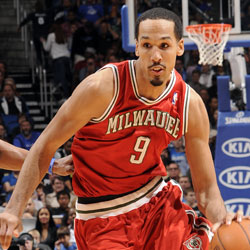
To waive or not to waive? That is the question with PG Shaun Livingston.
Perhaps the most interesting player on the bubble–at least from a cap management standpoint–is Livingston. A veteran 6-7 point guard capable of defending multiple positions, Livingston certainly brings something to the table to help the Rockets next season. However, his contract makes him either (a) expendable as a training camp cut or (b) a valuable in-season trade asset, depending on how the Rockets look at it.
If Livingston were waived prior to the start of the regular season, the Rockets would open up an additional $2.5 million in available cap room. On the other hand, if there is nothing imminently available for which that cap room would be needed, it could make more sense for the Rockets to hang onto Livingston and his contract.
First off, Livingston is probably one of the 15 most useful current Rockets players, so his inclusion on the regular season roster could at least contribute somewhat to some on-court success and/or the development of some of the younger guards. But perhaps just as importantly to this Rockets franchise in transition, Livingston’s contract–which contains no guarantee date–can be used during the season as a trade asset until it finally becomes guaranteed on January 10. Rather than opening up $2.5 million in extra cap room for trades by waiving him, the Rockets could instead take on as much as $4.35 million in additional guaranteed salary by trading Livingston.
Let’s say the Rockets make another move or two using their remaining cap room and perhaps even use the $2.5 million “Room” Exception to add a veteran free agent. They could later use Livingston’s contract to acquire a player making $5.35 million (or more, if the Rockets included other salaries in the deal), with the other team then able to waive Livingston and only pay him $1 million.
With all that said, the Rockets’ current cap situation may dictate that it’s simply not worth it to keep Livingston on the roster.
Unless the other team is gaining significant savings with a trade involving Livingston, it is likely that the Rockets would need to throw in at least $1 million in cash (or perhaps a future second round pick) in order to offset Livingston’s partial guarantee. My guess is that Rockets GM Daryl Morey would prefer to hang onto as much of his $3.1 million “Maximum Annual Cash Limit” (the maximum that teams can include in all trades combined during the 2012-13 season) for either a blockbuster trade for a star player or a draft day trade.
For all the potential benefits of keeping him around, the additional cap room–plus the additional young player who could be kept on the roster–may simply be more valuable to the Rockets than holding onto Livingston the Trade Asset.
Decisions, Decisions – Part 2: Exercise of Rookie Scale Contract Options
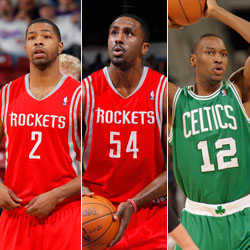
The Rockets will need to decide soon whether to exercise their team options for 2013-14 on Morris, Patterson and Johnson.
Which 15 players make the final regular season roster is not the only decision that Rockets brass will need to make during the month of October. They will also need to make longer-terms decisions on the futures of Patterson, Morris and Johnson, each of whom is a former first round pick who is at least one year in to his rookie scale contract. Patterson’s fourth-year team option (for just under $3.11 million) and Morris’s ($1.99 million) and Johnson’s ($1.14 million) third-year team options must be exercised by October 31.
The decision on Patterson seems like an easy one. Despite a lackluster second year, Patterson shows promise as a young big who can defend both down low and on the pick-and-roll. And based on reports out of offseason workouts, he is developing his post-up game, which was one of the key skills he possessed coming out of Kentucky in 2010 that caused the Rockets to rank him so high on their draft board. The team expects bigger things from Patterson this season, and they are likely willing to bet on him being worth his 2013-14 salary even before seeing whether he achieves any of their goals for him.
Morris has a lot to prove during training camp. Lauded by management a year ago as a poor man’s Carmelo Anthony (a “big 3” who can create his own shot and take advantage of either bigger or smaller defenders with his diverse set of offensive skills), Morris was a disappointment last season. While an ankle injury derailed a nice run he was having with the RGV Vipers, he also seemed to sulk at times over his lack of playing time and his being sent to the D-League during the season. In fairness to Morris, however, the lockout-shortened season and the Rockets’ salary cap balancing act provided little training camp or practice time for him to work on his transition from power forward to small forward, something that few young players can easily accomplish. Given where he was drafted and the relatively small price tag, it would be somewhat surprising if the Rockets did not pick up Morris’s option.
Perhaps one of the more interesting decisions to be made is with Johnson. A defensive stalwart out of Purdue in 2011, Johnson spent a year glued to the bench in Boston, learning his craft from one of the all-time greats at his position (Kevin Garnett). Most reports out of Boston were that the Celtics really didn’t want to part with Johnson but were forced to in order to acquire Lee from Houston. Unfortunately for Johnson, he joins a roster replete with power forwards. Even if he can manage to make the final cut for this season, he will need to truly impress the Rockets in training camp–and show that he is capable of playing multiple positions–in order for the team to commit to a guy who might not be more than the sixth big man on the 2013-14 roster.
Conclusion
With the utter disappointment of failing to acquire a superstar this offseason giving way (for many) to cautious optimism about the long-term potential for this young Rockets team (if not outright relief that The Dwightmare is over), Rockets fans can once again move forward. And despite being spurned yet again in their pursuit of a star player, the Rockets are still well-positioned to make a move if/when another star “shakes loose” (as Morey would say).
With a roster deep (if not top-heavy) in talent, there will be some interesting training camp battles this year. The Rockets are hopeful that such competition will only further improve their plethora of young players.
Bonus Footage
Here is my kid. He is smart. (Sorry, couldn’t resist.)
>> Comments