Connect with us
 

Houston Rockets

Houston Rockets Salary Cap Update

Now that the March 15th trade deadline has passed, let’s take a look at the Houston Rockets salary cap situation heading towards the 2012 NBA Draft and the 2012 offseason.

Published

on

Now that the March 15th trade deadline has passed, let’s take a look at the Houston Rockets salary cap situation heading towards the 2012 NBA Draft and the 2012 offseason.

The Rockets’ Latest Moves
Since my last update, the Rockets have made the following roster moves:

  • The Rockets waived Jeff Adrien prior to his contract becoming fully guaranteed.
  • The team signed Greg Smith on February 8 to a three-year deal for the league minimum.  The deal was fully guaranteed for this season, is 50% guaranteed for 2012-13 and is non-guaranteed for 2013-14.
  • At the trade deadline, the Rockets traded Hasheem Thabeet, Jonny Flynn and Minnesota’s 2012 second round pick (previously acquired with Flynn during last year’s draft) to the Portland Trailblazers in exchange for 6-11 center Marcus Camby.
  • Also at the trade deadline, the team traded Jordan Hill to the Los Angeles Lakers in exchange for Derek Fisher and the Dallas Mavericks’ 2012 first round pick.  The pick from the Mavericks (previously acquired by the Lakers in the Lamar Odom trade) is top-20 protected through 2017 and then becomes fully unprotected in 2018.
  • On March 16, the Rockets waived Terrence Williams.
  • On March 17, the team signed Courtney Fortson to a 10-day contract.
  • On March 19, the team reached a buyout agreement with Fisher. 

The Derek Fisher Buyout:  Cap Consequences
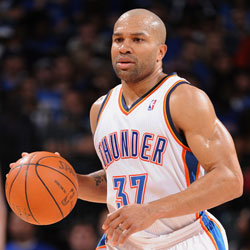
Derek Fisher Oklahoma City Thunder

The buyout benefited both the Rockets and Derek Fisher, who signed with the Thunder

Whether it was due to Fisher’s altruism or Daryl Morey’s hard-line stance in negotiations (or both), the Rockets ended up making out like bandits with Fisher’s buyout agreement.  Fisher elected to leave his entire 2012-13 salary ($3.4 million) on the table and to walk away from Houston, choosing instead to seek a key bench role on a title contender (which, sadly, the Rockets currently are not).  Shortly after clearing waivers, Fisher signed with the Oklahoma City Thunder.

However, due to league rules, Fisher was technically not allowed to waive his 2012-13 player option.

The most likely reason for the league’s denial of Fisher’s waiver of his player option may have been that Fisher’s contract included a set window during which his player option either be invoked or waived; and since this window had not yet opened, Fisher was not permitted to take any action with respect to his option.  Furthermore, league rules prohibit a team and its player mutually amending a player contract if the end result is to shorten the length of that contract, so Fisher and the Rockets could not even mutually agree to the waiver of the player option.  While the parties theoretically could have mutually agreed to eliminate the OPTION (making Fisher’s 2012-13 year fully guaranteed), they could not have eliminated the YEAR on his contract.  (Many thanks to Larry Coon for guidance on these technical contractual issues.)

Advertisement

So, rather than waive his option, Fisher and the Rockets agreed that Fisher’s buyout amount would be the equivalent of the remainder of his 2011-12 salary, which was then allocated across this year and next in proportion to what his remaining salary would have been had he not been bought out and had instead exercised his player option.  Since most buyouts do not include a setoff right for any additional salary the player makes on a new team — as opposed to the setoff typical for most waived players who are not bought out — Fisher’s new salary with Oklahoma City was not subtracted from (or “set off” against) the Rockets’ salary obligations.  And even had there been a setoff, it would not have affected the Rockets’ cap numbers; it would only affect salary paid.

The result?  The Houston Rockets will take a salary cap hit of $644,005 in 2012-13.

This is an almost negligible amount.  To put it in perspective, the league minimum salary for a player with only one full year of NBA experience is $762,195.  Given the Rockets’ penchant for making moves to gain further cap flexibility, this cap hit is rather inconsequential.

So, after the dust had settled on the Fisher trade and buyout, for the burden of taking this insignificant cap hit next season, the Rockets in essence paid almost nothing for a first round draft pick likely to be in the early 20s.  By comparison, most first round picks in that range cost a minimum of $3 million cash, if not the inclusion of future second round picks or the obligation of taking on a bad contract (like Fisher’s, had he not left so much money on the table).

I know it’s not the home run that we were all hoping for, but this trade turned out to be one hell of a deal for the Houston Rockets.

Advertisement

Summer of 2012:  Options, Options, Options
Barring any further roster moves, the Houston Rockets will have a minimum of approximately $35.01 million in salary commitments to six (remaining) players for the 2012-13 season: Kevin Martin ($12.44 million), Luis Scola ($9.41 million), Kyle Lowry ($5.75 million), Patrick Patterson ($2.10 million), Marcus Morris ($1.91 million), Chandler Parsons ($888,250), Fisher’s buyout ($644,005), a waived Samuel Dalembert ($1.5 million partial guarantee) and a waived Smith (about $381,000).

However, it is highly likely that the Rockets exercise the fourth-year option on Chase Budinger for the league minimum salary of $885,120.  It is also very likely that the Rockets will not waive Smith, since the additional amount he’d be owed if not waived would be less than the amount of a roster charge (should the Rockets have fewer than 12 players otherwise counting against their cap).  Add to that the rookie scale cap hold for Donatas Motiejunas ($1.13 million), who will likely be coming over next season, and the Rockets’ total salary commitments increase to about $37.41 million for nine players. 

Between the Rockets’ lack of other centers (Camby will be a free agent this summer) and the fact that he can walk and chew gum at the same time, it is probable that Dalembert will not be waived and that his full $6.7 million salary counts against the Rockets’ cap this summer.  That puts the Rockets’ cap figure at $42.61 million for ten players.  (NOTE:  I believe the Rockets have until July 8 to waive Dalembert without guaranteeing his entire salary; so there may be the possibility that a trade could be worked out during the July Moratorium with Dalembert being shipped elsewhere on July 8 for salary-matching purposes or as an attractive financial asset, with the acquiring team either keeping him or waiving him immediately in a salary dump. See my previous analysis of Dalembert’s contract)

Restricted free agent Courtney Lee will have a cap hold of about $5.56 million (more details on Lee’s free agency can be found here); and Goran Dragic, an unrestricted free agent, will have a cap hold of about $4.01 million (details on Dragic’s free agency here). With these additions, the Rockets’ total salary commitments further increase to $52.18 million for twelve players.

Based on next season’s salary cap figure ($58.044 million, at which the salary cap will be artificially set before resetting based on the new BRI split in 2013), in order for the Rockets to maintain rights to their current players, they will have approximately $5.87 million in salary cap room.   

Advertisement

That’s without taking into account (a) re-signing Camby, (b) the cap holds for the Rockets’ 2012 first round picks and (c) the increased cap figure for Motiejunas if the team signs him to 120% of his rookie scale salary in order to get him into summer league before the start of 2012 free agency. If, for example, the Rockets and the New York Knicks both miss the playoffs, Dallas secures a top-10 record, the Rockets end up with the # 11, # 14 and # 22 picks, and if the team signs each of those players and Motiejunas to 120% of their rookie scale salaries in order to get them into summer league play on time, then the Rockets would be left with only a negligible amount of available cap room with their current set of players (less than $440,000).   

Before anyone beats his/her head against a wall, decrying that the Rockets won’t have any cap room after all, the Rockets can just as easily have plenty of cap room.  If, for instance, the Rockets (1) make the playoffs, (2) timely waive Dalembert and (3) let Lee, Dragic and Camby walk in free agency, then their cap room with the current roster would jump up to about $17.03 million.

What this means is that the Rockets will be able to easily afford one maximum salary free agent… if they are willing (and, more importantly, able) to lure one to Houston.  They are also in a flexible enough position that they can make some minor moves (e.g., trading Dalembert, packaging multiple 2012 first round picks to move up or down, or even paying another team to eat a small salary) in order to keep one or more of their free agents.  Heck, if there just isn’t anything out there in free agency on which it’s worth using their cap space, the Rockets could even choose to bring back their free agents (assuming they can get them locked into reasonable deals) and save some cap room for 2013 (when Martin, Dalembert and others come off the books).

And almost none of this analysis takes into account that the Rockets will make trades.  If the 2012 NBA Draft ends without the Rockets having made at least one trade, I will be shocked.  A draft-day (or later offseason) trade of Martin or Scola could dramatically increase the Rockets’ available cap room to sign free agents or to provide further flexibility in future trades.

Conclusion
The Rockets have set themselves up nicely to make a run at a major acquisition next summer, either via free agency or via trade, by positioning themselves as one of several NBA teams that will have enough cap room to sign a maximum salary free agent.  Or they can make some moves for the future while still preserving salary cap flexibility for 2013 and beyond.  Or they can potentially add to their list of talented players on reasonably-priced deals if they retain Lee and/or Dragic, adding even more flexibility to trade other parts going forward in their pursuit of a star trade acquisition.

Advertisement

F-L-E-X-I-B- . . . well, you know the drill by now.

>> Comments

Analysis

Podcast: As trade season begins, will the Rockets make a splash?

Published

on

Photo by Ben DuBose, ClutchFans

In this roundtable conversation, ClutchFans Editor Dave Hardisty joins Ben DuBose and Paulo Alves to preview the NBA’s upcoming transaction window and its potential implications for the 16-7 Houston Rockets.

December 15 is when players who signed contracts in the preceding offseason become trade eligible, so the period from Monday until the in-season deadline of February 5, 2026, is likely to be among the most active on the 2025-26 calendar.

Discussion topics include roster needs and potential trade targets across the board, including the likelihood of bigger-name deals (such as Giannis Antetokounmpo, Jrue Holiday, and James Harden) and smaller acquisitions along the lines of Keon Ellis, Chris Paul, and Ayo Dosunmu.

The show also explores Houston’s potential desirability on the buyout market and the team’s long-term timeline for title contention, and specifically why those factors might make this a relatively quiet trade window for the Rockets.

Advertisement

Editor’s note: Hardisty and DuBose also host regular “ClutchFans Live” postgame recap shows on YouTube, while DuBose and Alves are co-hosts of the Rockets LaunchPod podcast, presented by ClutchFans and with support from SportsTalk 790 — official flagship radio station of the Rockets. Tune in to both shows for more coverage!

Continue Reading

Analysis

NBA front-offices poll: Rafael Stone’s Rockets rise to No. 3

Published

on

Photo via Houston Rockets, Rockets.com

At 15-6, the Rockets are currently tied for the second-fewest losses in the Western Conference standings, and they own the NBA’s No. 2 net rating.

And yet, just two years ago, Houston was coming off three straight rebuilding seasons with the worst record in the West.

It’s been a remarkable rise under the guidance of general manager Rafael Stone, who has combined the development of young players such as Alperen Sengun, Amen Thompson, Jabari Smith Jr., and Reed Sheppard with the acquisition of impact veterans — namely, Kevin Durant, Steven Adams, and the injured Fred VanVleet.

Making matters even better, the Rockets added and developed all that talent while still retaining several high-end future draft assets, to boot. Houston believes that draft equity can make it a sustainable contender for years to come, both in terms of having desirable trade assets and an ability to replenish its roster depth in cost-efficient ways.

Advertisement

With the 2025-26 regular season now at approximately its quarter pole, The Athletic recently canvassed 36 executives across the league — presidents, general managers, vice presidents, and assistant GMs — to rank the NBA’s top front offices.

Led by Stone, the Rockets’ front office comes in at No. 3, trailing only the last two champions — the Oklahoma City Thunder and Boston Celtics.

“High-end talent, a willingness to be bold, (and) good asset management,” one executive told The Athletic, when asked to sum up the Rockets.

Advertisement

Houston finished with one first-place vote; six second- and third-place votes, apiece; five fourth-place votes; and three fifth-place votes.

“They have drafted well, built a deep team in a tough Western Conference while managing tax aprons,” said one executive who voted the Rockets second. “(They) hired a good coach (Ime Udoka) and built an overall team identity, then added KD for cheap. From where they were only a few years ago, they have done a good job turning it around.”

Per Sam Amick of The Athletic, Stone “values this young core greatly and has frequently resisted the temptation to reach for overpriced roster shortcuts.” Udoka has an “influential voice” with the front office, as well, Amick adds.

Amick notes that the Durant trade came at a relatively low asset cost, adding that the Rockets are uninterested in pursuing a trade with the Memphis Grizzlies for disgruntled star Ja Morant.

The Athletic’s complete front-office rankings can be viewed here. This time a year ago, in the same exercise, Houston finished in a tie for the No. 11 spot.

Advertisement

Continue Reading

Analysis

With NBA Cup run complete, Rockets add Clippers, Nuggets to December schedule

Published

on

Photo via Houston Rockets, Rockets.com

After their Emirates NBA Cup 2025 elimination, the Rockets (12-4) learned two additional December dates for their 2025-26 regular season.

As announced Saturday by the league office, the Los Angeles Clippers (5-14) will visit Houston on Thursday, Dec. 11. Tipoff at Toyota Center will be at 7:00 p.m. Central.

Meanwhile, the Rockets (12-4) will then head to Denver on Monday, Dec. 15, where tipoff versus the Nuggets (13-5) is at 8:30 p.m. Central.

During Cup games, all three of the Clippers, Nuggets, and Rockets went 2-2 in Western Conference group-stage play. Because only four teams out of the 15 in each conference advance to the knockout rounds, a 2-2 record in group games isn’t usually enough to finish among the top four, and that was again the case this year.

Advertisement

To ensure that all teams play 82 regular-season games, teams who don’t advance then have two additional December games scheduled versus same-conference opponents who also did not advance.

In most cases, these add-on matchups come down to a formula. Taking Houston as an example, each season’s schedule includes two games (one home, one away) versus all East opponents and four games (two home, two away) versus most West opponents.

However, if that was the case for all same-conference opponents, the schedule would be at 86 games in length. So, there is a select group — rotating each year — of same-conference opponents on the docket only three times.

To trim down to 80 games (to account for the possibility of Cup advancement), the six West teams with only three dates on Houston’s initial 2025-26 schedule were the Clippers, Nuggets, Warriors, Oklahoma City Thunder, Minnesota Timberwolves, and Los Angeles Lakers.

Add-on games are typically chosen from that group, and the Thunder and Lakers advanced in Cup play, thus taking them off the table. So, it came down to two teams from the other four.

Advertisement

Led by James Harden, the reeling Clippers have yet to play Houston this season, though they will meet again on Dec. 23 in Los Angeles.

Meanwhile, the Nikola Jokic-led Nuggets enjoyed a close Nov. 21 victory in Houston. For the Rockets, Kevin Durant and Alperen Sengun each struggled in that game.

Now, less than a month later — in a matchup that could prove pivotal in the West standings race — Durant and Sengun (assuming health) will get an opportunity to make amends.

Denver and Houston are currently tied for the No. 3 spot in the West (trailing the Thunder and Lakers), though the Rockets are technically ahead by percentage points due to playing two fewer games. Thus, that Dec. 15 rematch could have significant stakes for both sides.

Advertisement
Continue Reading

Analysis

This Thanksgiving, the Rockets are thankful for Reed Sheppard

Published

on

Photo via Houston Rockets, Rockets.com

Relative to their expected formula from the 2025 offseason, the Rockets were missing five rotation players in Wednesday’s Thanksgiving Eve playoff rematch versus the Warriors.

Kevin Durant (personal reasons), Steven Adams (right ankle tendinopathy), and Tari Eason (right oblique strain) were all sidelined, and veterans Fred VanVleet (right knee) and Dorian Finney-Smith (left ankle) remain on the shelf after offseason surgeries.

Yet, the Rockets (12-4) still won for a 12th time in 14 games, and they overcame a 14-point road deficit against a high-profile Golden State squad featuring the likes of Steph Curry, Jimmy Butler, and Draymond Green.

The biggest reason was second-year guard Reed Sheppard, who set career-highs in points (31) and rebounds (9) while making 12-of-25 shots (48.0%), including four 3-pointers.

Advertisement

“He was big,” said head coach Ime Udoka, whose Rockets won despite shooting below 40% overall and 30% from 3-point range. “Reed really held us together when guys were struggling.”

For the season, Sheppard — a starter for Udoka over the past two games — is averaging 14.3 points, 3.3 assists, 2.8 rebounds, and 1.6 steals in 24.9 minutes per game. He’s shooting 48.8% overall and 45.5% on 3-pointers, with the latter figure coming in at No. 11 among hundreds of qualified NBA players.

But the advanced metrics are even more impressive. Per Basketball Reference, here’s where Sheppard ranks among his NBA peers in several impact categories:

• Box plus/minus (BPM): No. 5 (7.3)
• Defensive BPM: No. 6 (2.7)
• Offensive BPM: No. 15 (4.6)
• Win shares per 48 minutes: No. 10 (.208)
• Value over replacement player (VORP): No. 16 (0.9)
• True shooting (TS): No. 42 (62.9%)
• Player efficiency rating (PER): No. 40 (19.6)
• Steal percentage: No. 5 (3.3%)

Advertisement

The only players with a superior BPM are a quartet of annual Most Valuable Player (MVP) frontrunners in Nikola Jokic, Shai Gilgeous-Alexander, Giannis Antetokounmpo, and Luka Doncic. At the moment, Sheppard is the league’s highest-rated American player!

To say the least, those are remarkable efficiency metrics for a 21-year-old in his second NBA season. And it’s not as if Sheppard is posting those in low-leverage minutes, as evidenced by the key plays he made in the fourth quarter to help put the Warriors away.

“Defensively is where he’s shown the most improvement, overall,” Udoka said from San Francisco. “I think he’s taking on the challenge. The blow-bys are getting less and less. He’s catching up with the physicality of the game. Teams are going to try to attack him, at times, but like we said last year and during this summer, make them go east and west and stay in front of them. Help will come. He’s doing a great job of that.”

Sixteen games in, it’s no longer a particularly small sample. Rounding, it’s actually 20% of the 82-game regular season!

Advertisement

Assuming relative health, the 2025-26 Rockets had a high floor entering the season due to the All-Star presence of Durant and Alperen Sengun. But whether they could achieve a championship ceiling likely depended on further leaps from young players — most notably, the high-upside ones like Sheppard and Amen Thompson.

With Durant out, Thompson was the headliner in Monday’s road victory in Phoenix, and Sheppard stole the show two nights later at Golden State.

For everyone surrounding the organization, it’s an appropriate time to be thankful. With these leaps being shown from players who are extremely young and still improving, the Rockets appear set up to be a force in the Western Conference for quite some time.

“It’s going to be exciting when we get fully healthy and whole,” Udoka surmised.

Advertisement

Continue Reading

Analysis

2025 NBA Cup math, schedule update: Rockets unlikely to advance

Published

on

Photo via Houston Rockets, Rockets.com

Entering Thanksgiving week, all 30 teams have at least one of their four group-stage games remaining in Emirates NBA Cup 2025 action. Some have two.

But for the Houston Rockets (10-4 on the 2025-26 regular season, 1-2 in Cup play), elimination appears almost inevitable after Friday’s group-stage loss to the Denver Nuggets.

To explain why, let’s look at the Cup standings entering the week:

After their winning their group in the 2024 NBA Cup, the Rockets have already lost the possibility of doing so in 2025. Even if the Rockets win their group-stage finale at Golden State on Wednesday night, Houston’s best-case outcome is a 2-2 mark.

The only way 2-2 would be tied for the Group C lead is if Portland loses at home to San Antonio on Wednesday, followed by the Spurs winning at Denver two nights later. Without that combination of results, at least one of the Trail Blazers and Nuggets would have three group-stage wins, which inherently eliminates Houston.

But even if that unlikely 2-2 scenario somehow played out, the Rockets would be 1-2 against the other three teams in that 2-2 tie. The Spurs and Nuggets would each be 2-1, thus eliminating Houston as a potential group winner.

Advertisement

So, Group C is off the table.

Mathematically, the Rockets do remain alive for the wild-card slot, which goes to the top second-place finisher in each conference. For example, if this week’s games go according to the Vegas odds, it’s quite possible that the Spurs could defeat Portland but lose to Denver, creating a three-way tie between the Rockets, Trail Blazers, and Spurs at 2-2. Since each team would be 1-1 against the other two, head-to-head, it would come down to point differential — and Houston is well ahead of Portland (-18) and currently tied with San Antonio (+10) there.

Should Houston win that tiebreaker, the Rockets would finish second in in Group C. But looking at the remainder of the West, it’s unlikely for that to be enough to earn the wild card.

For starters, if any second-place team in Group A or Group B gets to three wins, the Rockets are automatically eliminated. Last season, both wild-card teams went 3-1 in group play.

But even if 2-2 somehow becomes enough for a tie, the point differential of the Minnesota Timberwolves (2-1, +53) and Oklahoma City Thunder (2-0, +63) will be difficult to overcome. At the moment, those teams — who play each other on Wednesday — are 43 and 53 points ahead of the Rockets, respectively.

Advertisement

So, in order for Houston’s 2-2 mark to somehow be enough to advance, the Rockets would need to make up at least 43 combined points between the final margin of their road game against the Warriors and the remaining group games for the Timberwolves and Thunder.

To say the least, that’s a tall order.

As a result, while not mathematically eliminated just yet, the odds are overwhelmingly against the Rockets advancing to the eight-team knockout phase.

There could, however, be some consolation. Should the Rockets improbably advance to the knockout rounds as a wild card, they would play on the road in the quarterfinal round. From there, should they win, their next game would be in Las Vegas for a neutral-site semifinal.

On the other hand, if the Rockets are eliminated, they would have two games added to their schedule versus West rivals who they are currently slated to play only three times (and not the usual four for most same-conference teams). These add-on games, which would be played during the week of Dec. 9-16, allow all teams to finish at 82 regular-season games in the final 2025-26 standings — i.e. the same as those who gain additional games from advancing to the knockout rounds. The Cup title game does not count toward regular-season standings.

Advertisement

For the Rockets, in contrast to the wild-card scenario, it’s worth noting that one of those two add-on games would be at home, inside Toyota Center.

The possible opponent pool consists of the Thunder, Warriors, Nuggets, Timberwolves, Los Angeles Lakers, and Los Angeles Clippers — and since these would be non-Cup matchups, it would have to be opponents who were also eliminated in group-stage play.

Breaking down that group of six, the home matchup would likely come against a team that is currently on the books for only one appearance in Houston this season. Based on the current schedule, that’s the Warriors, Nuggets, and Thunder.

Conversely, the other three teams — the Lakers, Clippers, and Timberwolves — are only scheduled to get one visit from Houston this season. So, those would likely be the three in the mix for Houston’s add-on road game.

Since the Warriors are almost certain to be eliminated after the Cup’s group stage — and the Nuggets and Thunder are likely to advance to the knockout rounds — the odds would suggest that Golden State becomes Houston’s additional home game in December.

Advertisement

For the add-on road game, the Timberwolves and the loser of Tuesday’s Lakers-Clippers Cup showdown — both Los Angeles teams are 2-0 in Group B, at the moment — would seem to be the strongest candidates.

So, relative to advancing in Cup play, being eliminated would give the Rockets one additional home game. Furthermore, if the add-on games become the Warriors and Clippers, both of those teams are currently at .500 or below this season. As a result, it’s probably to Houston’s scheduling interest for the Clippers to lose on Tuesday night, though it could be argued that the looming return of Kawhi Leonard makes them more of a threat.

Conversely, should Houston somehow advance, any knockout-round opponent would likely be a stronger team. After all, there’s probably a good reason why that team advanced.

It’s a small silver lining, but it’s not nothing. By not advancing in Cup play, the Rockets are likely to get one more home game at Toyota Center — and it’s likely to be a fun one versus Steph Curry, Draymond Green, and the hated Warriors.

For the Rockets and other teams across the league, those Dec. 9-16 matchups, dates, and times will be announced after the Nov. 28 conclusion of all group-stage games (schedule).

Advertisement

Continue Reading

Trending