Houston Rockets
Houston Rockets Salary Cap Update: “Total Rebuild” Edition
After closing the book on an all-too-brief 2011-12 NBA season and opening up the 2012 offseason with a flurry of activity, let’s take a look at the Houston Rockets’ current salary cap situation.
Published
14 years agoon
After closing the book on an all-too-brief 2011-12 NBA season and opening up the 2012 offseason with a flurry of activity, let’s take a look at the Houston Rockets’ current salary cap situation.
The Rockets’ Latest Moves
Since my last update, the Rockets have made the following roster moves:
- Prior to the end of the season, the Rockets signed Courtney Fortson and Diamon Simpson each to two-year deals for the league minimum, with team options on the second year with a non-guaranteed salary (the options were subsequently picked up).
- On June 26, the team traded Chase Budinger and the draft rights to Lior Eliyahu to the Minnesota Timberwolves in exchange for the #18 pick in the 2012 NBA Draft.
- On June 27, the Rockets traded the #14 pick in the 2012 NBA Draft, Samuel Dalembert, their 2014 second round pick and cash considerations to the Milwaukee Bucks in exchange for the #12 pick in the 2012 NBA Draft, Shaun Livingston, Jon Brockman and Jon Leuer.
- The Rockets selected Jeremy Lamb (#12), Royce White (#16) and Terrence Jones (#18) in the 2012 NBA Draft.
- The team purchased the draft rights to Turkish power forward Furkan Aldemir (the #53 pick in the 2012 NBA Draft) in a four-team trade involving the Los Angeles Clippers, the Dallas Mavericks and the Utah Jazz.
- During the July Moratorium, the team signed Donatas Motiejunas to his first round rookie scale contract at the maximum permitted 120% of his scale salary.
- On July 11, the Rockets traded Kyle Lowry to the Toronto Raptors in exchange for Gary Forbes and a future first rounder that is a likely lottery pick.
- Also on July 11, the team signed and traded Marcus Camby to the New York Knicks in exchange for Toney Douglas, the non-guaraneed contracts of Josh Harrellson and Jerome Jordan, and the Knicks’ second round picks in 2014 and 2015.
- On July 13, the Rockets waived Luis Scola via the amnesty provision, clearing his salary off of the team’s salary cap. (Scola was subsequently claimed off waivers by the Phoenix Suns with a partial claim bid; and the Suns will pay Scola approximately $4.5 million per season for each of the next three years, with the Rockets paying the rest of the $31 million remaining on Scola’s contract. Major credit to Rockets owner Leslie Alexander for his willingness to pay $17.5 million for one of his best players to NOT play for him, all in the name of salary cap flexibility to pursue the opportunities necessary to return the team to championship contention.)
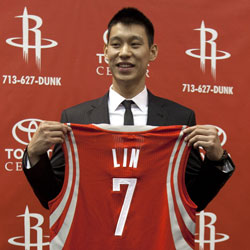
- The Rockets signed Jeremy Lin to a three-year, $25.1 million offer sheet on July 14, which was not matched by the New York Knicks.
- On July 18, the team waived Leuer and Jordan. (Leuer was subsequently claimed off of waivers by the Cleveland Cavaliers.)
- On July 20, the Rockets signed and traded Courtney Lee to the Boston Celtics in exchange for JuJuan Johnson, the non-guaranteed contracts of Sean Williams and E’Twaun Moore, the draft rights to Jon Diebler, and the Charlotte Bobcats’ 2013 second round pick previously acquired by Boston. (Moore was subsequently waived.)
- The team signed Omer Asik to a three-year, $25.1 million offer sheet on July 21, which was not matched by the Chicago Bulls.
Explaining the Lin and Asik Deals
As noted above, Lin and Asik each signed (presumably) identical three-year, $25.1 million offer sheets with the Rockets. Because both players fall within the unique category of high-quality restricted free agents with only one or two years in the league (both are two-year veterans), Lin and Asik were subject to what has become commonly known as the “Gilbert Arenas” provision of the CBA, or the Arenas Rule. (More on the “Gilbert Arenas” provision can be found here).
The Arenas Rule prohibits any team from offering these types of players a starting salary greater than the Non-Taxpayer Mid-Level Exception ($5 million for 2012-13) and only a 4.5% raise in Year 2 of the contract (in this case, $5.225 million). Starting in Year 3, the salary can balloon to up to the applicable maximum player salary. Like with other restricted free agents, the player’s former team has the right to match any offer for the player.
The rationale for these salary limits is that the player’s former team must be allowed at least some avenue by which to potentially match any offer sheet, either via Early Bird rights (which allows a team to pay up to the average player salary for a player coming off a two-year contract or having spend two years with the team) or the Non-Taxpayer Mid-Level Exception (for Non-Bird free agents with only one year with the team). The reason for the ballooning of the salary in Year 3 is that the player’s former team would have obtained full Bird rights on such player by that time and would then be allowed to offer such player a maximum salary.
From a salary cap standpoint, if the team extending the offer sheet wishes to give such a player a raise greater than 4.5% in Year 3 of the offer sheet, it must have at least enough cap room available to cover the average annual salary; and the player will count against the offering team’s salary cap (and for luxury tax purposes) at that average figure in each year of the offer sheet. However, unless the player’s former team has a similar amount of available cap room, it must have the player’s actual salary from year to year count against its salary cap and luxury tax calculations.
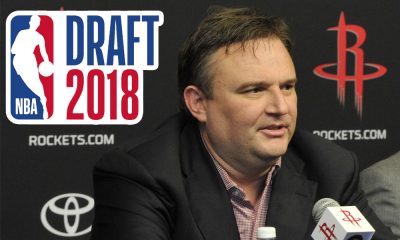
For lack of a better term, Rockets GM Daryl Morey and the Houston front office “artfully exploited” the Arenas Rule.
By limiting the Lin and Asik offer sheets to only three years (as opposed to four-year deals), the Rockets were able to concentrate the balloon payment into Year 3, rather than having some of that ballooning salary spread over multiple seasons. The offer sheets will pay Lin and Asik the maximum player salary for five-year veterans (approximately $14.898 million), making it extraordinarily painful for either New York or Chicago (both tax-paying teams) to match. The cap hit for Houston on each player is $8.37 million in each season; but the cap hit to their former teams would be $5 million in 2012-13, $5.225 million in 2013-14 and $14.898 million in 2014-15 (which is the actual payment schedule, even for Houston).
Making matters worse for the Knicks and Bulls, the year in which the massive cap hit for their now-former players would occur (the 2014-15 season) is also the first year in which the league’s most punitive luxury tax — the “repeater tax” — will impact teams that are taxpayers in each of the three prior seasons. Is it any coincidence that both New York and Chicago project as taxpayers in each of those season? I think not.
For those wondering what the salary cap impact would be if the Rockets later decide to trade either Lin or Asik, the receiving team would get the player at the same $8.37 million per year cap hit at which Houston has them. While it is still not completely clear how the actual salary payments would be treated, those would presumably be covered by the receiving team in full. In other words, if the Rockets traded Asik to another team in the summer of 2014, Asik would only count $8.37 million for salary-matching purposes, but his entire $14.898 million salary for 2014-15 would presumably need to be covered by his new team (the Rockets would likely be unable to contribute more than the maximum $3.3 million cash allotment permitted).
Salary Commitments and Potential Cap Room
(DISCLAIMER: Further roster moves will likely be made. The figures below probably do not represent the Rockets’ true cap situation once such additional moves are made; they are solely intended to give you a picture of the Rockets’ current cap situation.)
Barring any further roster moves, the Houston Rockets now have approximately $53.50 million in team salary for the 2012-13 season: Kevin Martin ($12.44 million), Lin ($8.37 million), Asik ($8.37 million), Livingston ($3.5 million, only $1 million of which is guaranteed), Patrick Patterson ($2.10 million), Douglas ($2.07 million), Marcus Morris ($1.91 million), Forbes ($1.5 million), Motiejunas ($1.36 million), Johnson ($1.09 million), Brockman ($1 million), Williams ($915,852, non-guaranteed if waived by August 1), Chandler Parsons ($888,250), Greg Smith ($762,195, of which 50% is guaranteed), Fortson ($762,195, non-guaranteed), Simpson ($762,195, non-guaranteed), Harrellson ($762,195, non-guaranteed if waived by August 15), the rookie scale cap holds for Lamb ($1.68 million), White ($1.37 million) and Jones ($1.24 million), and the cap hit from the Derek Fisher buyout ($644,005; more on that here).
Based on this season’s maximum salary cap of $58.044 million, in order for the Rockets to maintain rights to all of their current players, they will have approximately $4.55 million in salary cap room. If the Rockets simply waive their fully non-guaranteed contracts (Williams, Fortson, Simpson and Harrellson), though, that number jumps to approximately $7.75 million in cap room. In the event that the Rockets decide to waive (and eat the partial guarantees on) Livingston and Smith, that figure could conceivably reach as high as $10.63 million. However, those figures could be reduced slightly (by up to $858,440) if one or more of the 2012 first round picks end up signing contracts with the Rockets for up to the maximum permitted 120% of their rookie scale salaries.
Contrary to the popular belief of the national media, the Rockets still have PLENTY of cap flexibility to pursue free agents and trades — namely, for a certain Orlando Magic center — even after signing both Lin and Asik to lucrative deals.
Potential Superstar Acquisition
Much has been made of the Rockets’ pursuit of Dwight Howard. Houston is currently (and finally!) being recognized by most of the mainstream media as the frontrunners to either land Howard or possibly acquire another piece (like Lakers center Andrew Bynum) as part of a three-team trade with Orlando. The Rockets possess the unique combination of (1) enticingly high draft picks (most notably, the Toronto pick acquired in the Lowry trade), (2) high-ceiling young players (in particular, Lamb, Motiejunas and Parsons) and (3) the cap flexibility — via cap room and/or expiring or non-guaranteed contracts — to take on some additional salary from Orlando in order to clear the Magic’s books for a fresh start post-Howard.
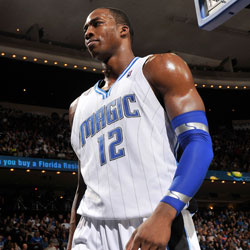
Because the Rockets possess the potential for either/both (A) significant cap room (if they waive all of their non-guaranteed contracts) to absorb incoming Orlando players and/or (B) salary-matching trades financially beneficial to Orlando (if the Rockets instead use expiring or non-guaranteed contracts for salary-matching purposes), there are countless scenarios in which a Howard-to-Houston trade can be accomplished. It is virtually impossible to predict which players, picks and other assets will be included in whatever trade might end up happening. However, in order to illustrate the Rockets’ cap flexibility, I will walk through one hypothetical variation of such a trade.
Let’s say the Rockets trade Martin, Patterson, Lamb, Jones, the Toronto first round pick, the Dallas first round pick and the Charlotte second round pick to Orlando in exchange for Howard ($19.54 million), Jason Richardson ($5.8 million in 2012-13, $6.2 million in 2013-14 and a $6.6 million player option in 2014-15) and Chris Duhon ($3.25 million in 2012-13 and $3.5 million in 2013-14, only $1.5 million of which is guaranteed if waived on or prior to June 30, 2013).
(NOTE: This does not in any way reflect what I think will or should happen and yes, I know that’s a lot to give up for that Orlando package. All the more reason to use this as the hypothetical.)
By waiving all of their non-guaranteed contracts, the Rockets can create sufficient cap room to absorb the salaries for Richardson and Duhon, while sending Orlando back only draft picks and the draft rights to Lamb and Jones. Then, with the Rockets largely capped out by that first component trade, they could then ship Martin and Patterson to Orlando for Howard. (FYI, the Martin-Patterson combination comes out to virtually the absolute least salary an over-the-cap team could trade to get back Howard’s contract.)
Different variations of a Howard trade (including the hypothetical above) will likely generate various trade exceptions to Houston and/or Orlando; and some scenarios could be conceived to potentially create a very large trade exception. Do not be surprised if a final Howard trade configuration has the result of generating a huge trade exception for Orlando. Magic GM Rob Hennigan is creative enough to structure it that way.
Other Trade Options
The pursuit of a mega-trade for a star player is not the only use to which the Rockets can put their cap room. By being under the salary cap, so long as the Rockets do not exceed the maximum salary cap by more than $100,000 upon completion of a particular trade, the team would not be subject to either salary matching rules or the 60-day waiting period to aggregate salaries of players acquired in prior trades. In other words, if the Rockets are $10 million below the cap, (1) they can trade a $2 million player in exchange for another team’s player making up to $12.1 million or (2) they can aggregate the salaries of Douglas ($2.07 million, recently acquired from New York), Johnson ($1.09 million, recently acquired from Boston) and Brockman ($1 million, recently acquired from Milwaukee) in exchange for another team’s player making up to $14.2 million.
If the Rockets cannot find another player — either via free agency or trade — who is worth pursuing or is willing to sign with/come to Houston, then having available cap room can benefit the team in other ways. For instance, the Rockets can help facilitate trades between two or more other teams that might not otherwise be able to complete their trade without use of the Rockets’ cap room. In exchange for facilitating a trade, the Rockets would receive some consideration, be it cash, picks or players.
Also, they could just sit on their cap room and wait for a team to get desperate enough to trade them something for the privilege of using that room. Oklahoma City used this strategy a few years ago with Utah (then fearful of paying the luxury tax), which coughed up talented young point guard Eric Maynor in exchange for the Thunder taking on the remaining few months of Matt Harpring’s contract (which itself was largely covered by insurance).
Believe it or not, the Rockets actually have assets other than cap room that they can use in trades this summer. Patterson, Morris, Parsons, Motiejunas, Lamb, White and Jones all have some decent trade value as young prospects. The Toronto pick is extraordinarly valuable. The future Dallas first rounder is another nice asset, as is the Charlotte second rounder. The Rockets hold the draft rights to at least two players — All-Euroleague point guard Sergio Llull and the aforementioned Aldemir — who may interest teams now or in the future.
Martin will have a $12.44 million expiring contract while still being a very productive offensive player. Those anxious to “dump” Martin at the first chance, please note that Martin’s expiring contract may be more valuable in trades than $12.44 million in additional cap space. The Rockets can take back up to $17-18 million in incoming salary in exchange for Martin’s outgoing salary.
Conclusion
I know there is a great feeling of disappointment by many fans after the Rockets ended the 2012 NBA Draft without a superstar or a top-5 pick. Fortunately, the stellar play of the team’s rookies in the NBA Summer League in Las Vegas last week, together with all the rumored Howard trade talk, has seemingly caused such disappointment to dissipate.
Meanwhile, the Rockets have set themselves up nicely to make a run at a major acquisition in the coming months, either via free agency or trade, by positioning themselves as one of few NBA teams with both cap room and a slew of tradeable assets. They have compiled so many assets in the past 2-3 years that they can afford to “overpay” for a talent upgrade if necessary. Or they can make some moves for the future while still preserving salary cap flexibility for 2013 (when the Rockets, with their current roster, could conceivably have as much as $27 to 32 million in cap room!) and beyond, adding even more flexibility to trade other parts going forward in their pursuit of a star acquisition.
It’s only fitting that Morey is on his way to the Summer Games in London. He, with significant help from Mr. Alexander and the rest of the Houston front office, has given the Rockets the flexibility of an Olympic gymnast.
>> Comments
Houston Rockets
Rockets re-sign Tari Eason, lose two veteran defenders
Published
1 day agoon
July 4, 2026By
Ben DuBoseIn the days immediately following their free agency signings of Marcus Smart and Bogdan Bogdanović, the Houston Rockets were linked to several other transactions of significance.
First came the re-signing of restricted free agent Tari Eason, who will now be on a five-year, $81.5-million contract with the team. The fifth and final season is a player option, and the deal includes a 10% trade kicker, per The Athletic’s Sam Amick.
A 6-foot-8 forward, Eason remains one of the most valuable and versatile defenders for head coach Ime Udoka. Now 25 years old, he was drafted out of LSU in the 2022 first round.
Eason’s deal was first reported by ESPN’s Shams Charania on Thursday night.
The Rockets could get under the first apron and potentially the luxury tax depending on how they structure this contract and by trading Dorian Finney-Smith.
Assuming the roster is mostly set, their last big piece of business of the offseason is extending Amen Thompson. https://t.co/qKhNnDTPz3
— Yossi Gozlan (@YossiGozlan) July 3, 2026
In the 2026 playoffs, Eason ranked second among Houston’s rotation players in on-off differential, trailing only Amen Thompson.
Then, a day after the Eason news, Houston parted ways with two of its defensive acquisitions from the 2025 offseason. In a move designed to clear salary and open a roster spot, the Rockets moved Dorian Finney-Smith and three second-round picks to Charlotte.
As part of the deal, Houston will generate a $13.3-million trade exception (the amount of Finney-Smith’s 2026-27 salary) that lasts for one year.
The Rockets save over $20 million against their payroll and tax and get under the first apron by salary dumping Dorian Finney-Smith.
They create a $13.3 million trade exception and are in a position to field the rest of the roster while staying under the luxury tax line https://t.co/gc1mW4eTPq
— Yossi Gozlan (@YossiGozlan) July 3, 2026
Per ESPN’s Bobby Marks, the second-round selections headed to Charlotte include Houston’s own picks in 2028 and 2033 and one from the Memphis Grizzlies in 2027.
After undergoing ankle surgery in the 2025 offseason, Finney-Smith struggled mightily in his one season in Houston and never recaptured his previous form. In turn, that forced the Rockets to pay a premium (second-round picks) to financially offload his deal.
Finney-Smith signed with Houston in July 2025, and the team did not learn until checkpoints in the weeks and months ahead that his June 2025 procedure did not resolve a longstanding ankle issue. The 33-year-old forward had yet to join the Rockets when he underwent surgery, which was performed by doctors elsewhere.
Finally, later that same day, reserve wing Josh Okogie agreed to a two-year, $12-million deal with the Utah Jazz. While the Rockets did have interest in a reunion, Okogie’s potential minutes and salary in Houston had decreased due to the signings of Smart and Bogdanović.
Free agent F/G Josh Okogie has agreed to a two-year, $12 million deal with the Utah Jazz, sources tell ESPN. Okogie — a wing defender who shot 38.5% from 3 last season in Houston — considered several suitors before the Jazz received the commitment tonight from Okogie and his… pic.twitter.com/Bh9RN9KaHo
— Shams Charania (@ShamsCharania) July 4, 2026
Smart is widely viewed as a superior defensive player who can also handle the ball, while Bogdanović is a career 38.1% 3-point shooter at high volume. After losing in the first round of the 2026 Western Conference playoffs, Udoka spoke of the importance of diversifying the types of players on Houston’s bench, where more shooting was clearly a need.
At the moment, Houston has two available roster spots within its potential 2026-27 depth chart. Assuming both are minimum signings, the Rockets will be able to stay beneath the NBA’s luxury tax threshold and delay the onset of punitive “repeater tax” penalties.
Among players from the 2025-26 Rockets, a team source told ClutchFans that Isaiah Crawford and Jae’Sean Tate are potential candidates for those final roster spots. It appears the team will likely move on from 39-year-old forward Jeff Green and 29-year-old guard Aaron Holiday, whose role was clearly in doubt following the 2026 draft selection of Bruce Thornton.
Houston’s 2026 summer league schedule begins Friday, July 10, in Las Vegas, where the Rockets can evaluate players such as Thornton, Crawford, and recent two-way contract signing Quadir Copeland for potential roles with the 2026-27 Rockets.
Rockets updated depth chart:
PG: Fred VanVleet, Reed Sheppard, Bruce Thornton, JD Davison
SG: Amen Thompson, Marcus Smart, Bogdan Bogdanovic
SF: Kevin Durant, Tari Eason
PF: Jabari Smith Jr
C: Alperen Şengün, Steven Adams, Clint CapelaTwo roster spots still open.
— Will Guillory (@WillGuillory) July 3, 2026
Sights on Vegas 🎰 pic.twitter.com/0s03Bqe9nH
— Houston Rockets (@HoustonRockets) July 3, 2026
Analysis
Rockets land Marcus Smart, Bogdan Bogdanović in free agency
Published
4 days agoon
July 1, 2026By
Ben DuBose
Within the first 24 hours of the NBA’s 2026 free agency window, the Houston Rockets reached two agreements to fortify the depth of their 2026-27 roster.
Veteran guard Marcus Smart, who torched the Rockets in the 2026 playoffs while with the Los Angeles Lakers, is joining Houston on a two-year, $13-million deal.
Smart remains one of the NBA’s most impactful defenders, and he won Defensive Player of the Year honors while playing for Rockets coach Ime Udoka with the 2021-22 Boston Celtics.
Meanwhile, Serbian sharpshooter Bogdan Bogdanović is joining Houston on a one-year, minimum-salary contract. He played for portions of the past two seasons with the Clippers.
Bogdanović has shot 38.1% on 3-pointers over nine NBA seasons, and he remains an accomplished international player for Serbia, as well.
More information on both offseason signings is available at USA TODAY’s Rockets Wire, and our Rockets LaunchPod (presented by ClutchFans) has initial reaction below.
As of today, Houston’s starting lineup for the 2026-27 season appears likely to feature Fred VanVleet, Kevin Durant, Amen Thompson, Jabari Smith Jr., and Alperen Sengun.
Key reserves will include Smart, Reed Sheppard, Tari Eason (a restricted free agent), Bogdanović, and Steven Adams.
The Rockets are coming off consecutive seasons with 52-30 records before being defeated in the first round of the Western Conference playoffs, and the team’s internal hope is that its newfound depth — along with having Durant, VanVleet, and Adams available in the 2027 playoffs — will help next year’s team get over that hump.
Houston Rockets salary cap situation after signing Marcus Smart and Bogdan Bogdanovic.
They can exceed the first apron by using the taxpayer mid-level on Smart.
There is now less pressure to move Dorian Finney-Smith to accommodate a Tari Eason signing. pic.twitter.com/k5f1zq8KQ3
— Yossi Gozlan (@YossiGozlan) July 1, 2026
Houston Rockets
Rockets linked to Kawhi Leonard in transaction rumors
Published
6 days agoon
June 29, 2026
With 2026 free agency negotiations set to open Tuesday, the landscape of the NBA has already shifted dramatically.
The Miami Heat emerged as winners of the Giannis Antetokounmpo sweepstakes, acquiring the All-NBA forward in a blockbuster trade. The Charlotte Hornets have also been among the most active teams, trading away LaMelo Ball and Miles Bridges in a pair of deals.
With more fireworks expected this offseason, questions remain about whether the Houston Rockets will join the wave of big trades and signings.
The Rockets have remained absent from most speculation involving star players, outside of minor rumors about interest in Celtics guard Jaylen Brown (which were later dismissed).
But one intriguing name to monitor is Los Angeles Clippers forward Kawhi Leonard, amid uncertainty surrounding his availability. Sportsnet’s Michael Grange recently reported that the two-time Finals MVP could possibly seek a trade, with the San Antonio Spurs and Toronto Raptors — two of his former teams — listed as preferred destinations.
Grange, who correctly linked Houston to a Fred VanVleet signing in 2023, then noted that the Rockets “could also be part of that mix.” Any interest would likely be mutual, since it wouldn’t make sense to pursue Leonard — who is entering the final year of his existing contract in 2026-27 — without feeling confident that he would extend his deal.
The Houston Rockets could be in the mix of trading for Kawhi Leonard, per @michaelgrange
“With reports circulating that the two-time Finals MVP would be open to reuniting with his former teams, San Antonio and Toronto, though the Houston Rockets could also be part of that mix”… pic.twitter.com/uqP7yKyOZX
— Fullcourtpass (@Fullcourtpass) June 27, 2026
Leonard, entering his 13th season, remains one of the league’s premier scorers. Now 35 years old, the 6-foot-6 forward averaged a career-high 27.9 points per game last season while shooting 50.5% from the field and 38.7% from 3-point range.
Beyond his offensive production, Leonard is still one of the NBA’s best two-way players. He’s won two Defensive Player of the Year awards, a skill set that aligns with head coach Ime Udoka’s defensive philosophy.
What Would Be the Cost for the Rockets?
Ideally, Leonard would have his current contract voided as part of the league’s ongoing Aspiration investigation. With free agency negotiations opening Tuesday, cap space around the league will be occupied within a few days, which would soon put Houston on comparable financial footing relative to other suitors.
Should that not happen, the other option to potentially acquire Leonard would be by trade.
In any deal, VanVleet is one player to monitor. The 32-year-old guard has a player option worth $25 million that he exercised Monday, and speculation has increased following recent social media activity that some fans interpreted as cryptic messaging.
On Thursday, he reposted an X post from over 10 years ago that read, “Bet on yourself.” He then added a “note taking” emoji.
— Fred VanVleet (@FredVanVleet) June 25, 2026
He later posted a more extensive message on Instagram:
“Operating at a higher frequency is uncomfortable, especially at first. But don’t feel bad for apologizing or compromising yourself to accommodate your environment. Stay true to self. The decision to better yourself comes with a cost. Stay down.”
Whether tied to a potential Leonard deal or not, a departure from VanVleet is certainly possible, since he won’t have the implied no-trade clause in 2026-27 that he did in 2025-26.
Furthermore, it’s worth noting that the Rockets traded up in the second round to select Ohio State guard Bruce Thornton, a player whose style shares similarities with VanVleet. With Udoka having expressed reluctance toward roster duplication and rumors swirling regarding the potential acquisition of Lakers guard Marcus Smart, the writing could be on the wall.
From an asset perspective, the Clippers might also seek All-Star center Alperen Şengün in any deal. Sengun’s presence could help Los Angeles fill a frontcourt void after trading away Ivica Zubac at February’s trade deadline. Sengun, who turns 24 in July, would also be in age alignment with 26-year-old guard Darius Garland (who the Clippers traded for in February).
Because Houston would need to trade away a comparable financial number to Leonard’s $50.3 million for salary matching, some combination of larger contracts — such as VanVleet, Sengun ($35.6 million), and Dorian Finney-Smith ($13.3 million expiring) — would need to go out in order for a deal to work under the NBA’s Collective Bargaining Agreement.
The bottom line: Just one year after acquiring veteran star Kevin Durant, the Rockets could once again find themselves at the center of another chaotic offseason.
Whether history repeats itself remains to be seen.
Houston Rockets
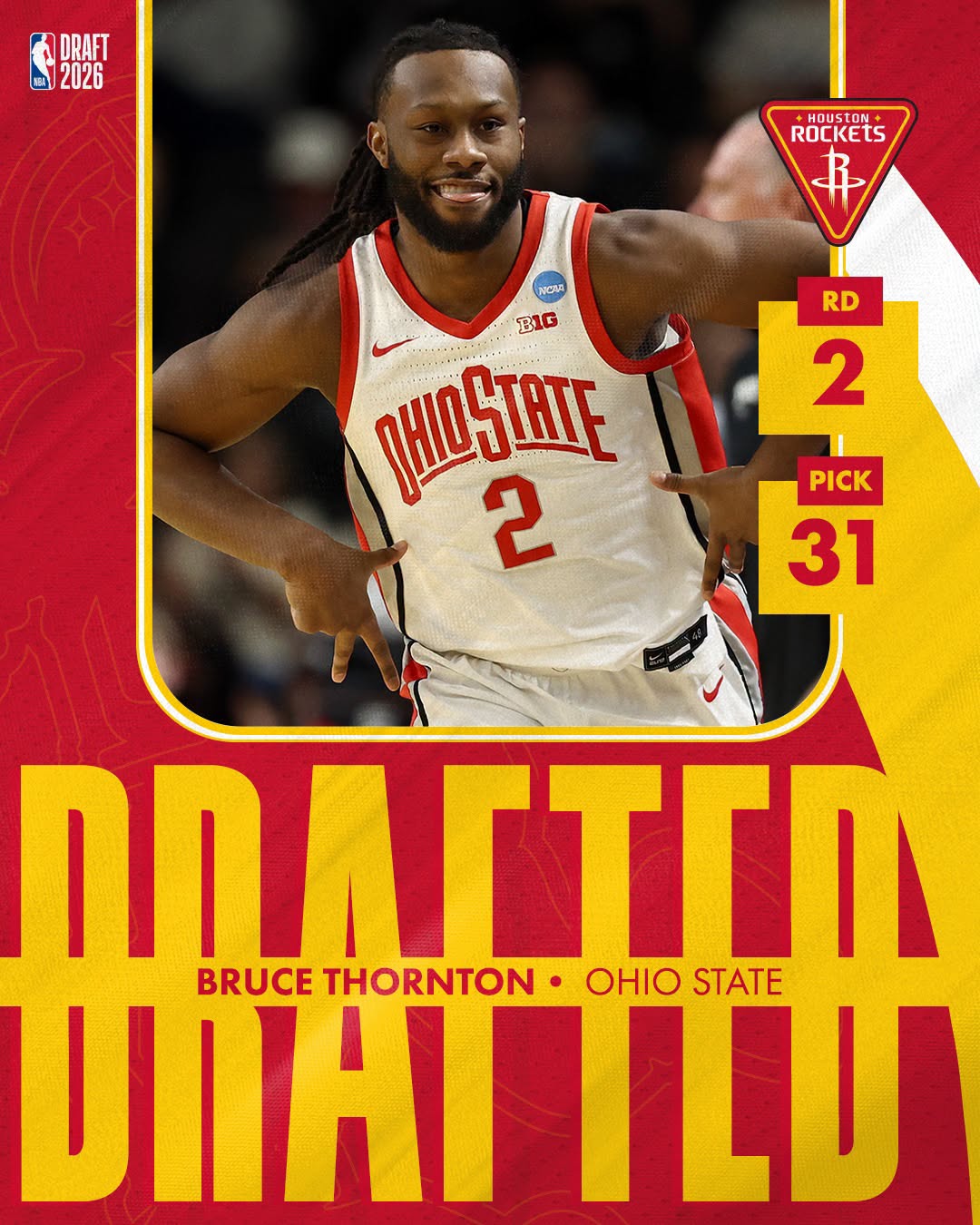
Rockets draft Ohio State guard Bruce Thornton at No. 31 overall
Published
1 week agoon
June 25, 2026
After entering the 2026 NBA draft without a first-round pick in one of the deepest classes in recent memory, the Rockets wasted no time making moves in Wednesday’s second round.
Houston traded the No. 39 and No. 53 pselections, along with a 2029 second-round pick via Sacramento, to the defending NBA champion Knicks in exchange for the No. 31 and No. 55 selections. The Rockets then used the No. 31 pick to select Ohio State guard Bruce Thornton.
In his final season with the Buckeyes, Thornton averaged 19.9 points, 5.1 rebounds, and 4.6 assists while shooting 55% from the field and 40% from 3-point range.
Thornton leaves Ohio State as one of the most decorated players in program history. He finished his career as the school’s all-time leading scorer with 2,164 points over four seasons and served as a team captain for four consecutive years — a leadership trait frequently highlighted by scouts leading up to the draft.
Thornton adds much-needed perimeter shooting to the Rockets’ roster, as evidenced by his 40% 3-point shooting clip as a senior. He did that on relatively high volume at just under five attempts a game, though he also possesses the ability to create offense off the dribble.
While officially listed at 6-foot-0, Thornton plays with physicality on both ends of the floor and often uses his 223-pound frame and 6-foot-5 wingspan to compensate for his lack of height.
Rockets take 6-0 guard Bruce Thornton out of Ohio State with the 31st pick. 4-year player, turns 23 just before camp. 6-5 wingspan, shot 41.2% from three the past two seasons. Strong dude, can create his own shot and boosts the shooting. He likely replaces Aaron Holiday on the… pic.twitter.com/58SLyMPeTQ
— ClutchFans (@clutchfans) June 25, 2026
Thornton’s career outline is one that, decades ago, was a routine. Today, however, it is a relative anomaly to play all four collegiate seasons at one university.
A 22-year-old entering the draft can be viewed as a negative to some NBA general managers, who might covet more youth and perceived upside. But for a Rockets team ready to compete for a championship now, Thornton’s experience may be an ideal addition to the roster.
Tom Izzo, the legendary Michigan State coach, showed clear respect to Thornton after watching the Ohio State guard score 32 points during a Big Ten matchup in February.
“I said to him before the game, it’s been a privilege to have him in our league,” Izzo said. “He’s handled himself well, he stayed in the same place, he’s been an unbelievable performer. He’s got class. I’m a big Bruce Thornton fan.”
Most second-round picks are not expected to become immediate rotational players in the NBA. But depending on Houston’s free-agent moves, Thornton could have a path to playing time with the 2026-27 Rockets.
As currently constructed, Thornton could compete with Aaron Holiday (a pending free agent) for minutes as the team’s third point guard behind Fred VanVleet and Reed Sheppard.
There's a lot to like here with Bruce Thornton. He's built very similarly to a Kyle Lowry.
Lowry was 6'0.25" barefoot, 195 pounds and a 6'4" wingspan.
Thornton is 6'0" barefoot, 223 pounds and a 6'5" wingspan.
He takes care of the ball (assist-to-turnover ratio is strong) and… pic.twitter.com/itGtDff8QF
— ClutchFans (@clutchfans) June 25, 2026
Houston Rockets
Rockets unveil new uniforms, branding for 2026-27 season
Published
1 month agoon
June 4, 2026By
Ben DuBoseThe Houston Rockets are unveiling a bold new look for the franchise, one which honors the past while attempting to push Rockets basketball into an exciting next chapter.
“Rooted in the energy, pride, and championship spirit of Houston, the new brand identity brings back the iconic ketchup-and-mustard color palette that helped define Rockets basketball for decades,” the team writes in its press release.
Yet, along with the ketchup-and-mustard scheme is a modern collection of logos, uniforms, and apparel designed for the future.
“We heard our fans,” said Patrick Fertitta, vice chairman of the Houston Rockets and Comets. “Ketchup and mustard is back! From the time my family bought the team in 2017, we’ve heard from countless fans about how deeply those colors are tied to their memories. We wanted to create something that celebrates the generations of fans who built Rockets basketball while inspiring the next generation of fans.”
Red returns as the heartbeat of the franchise, according to the team, while “championship yellow” is an effort to reconnect past greatness to the future ahead.
The “R” logo remains at the center of the new look and reinforces the organization’s core identity. Meanwhile, the reimagined “Dunkstronaut” blends nostalgia with innovation and further connects the franchise to the spirit of “Space City.” The new global logo draws inspiration from NASA mission patches, with two quasars symbolizing the franchise’s journey from San Diego to Houston.
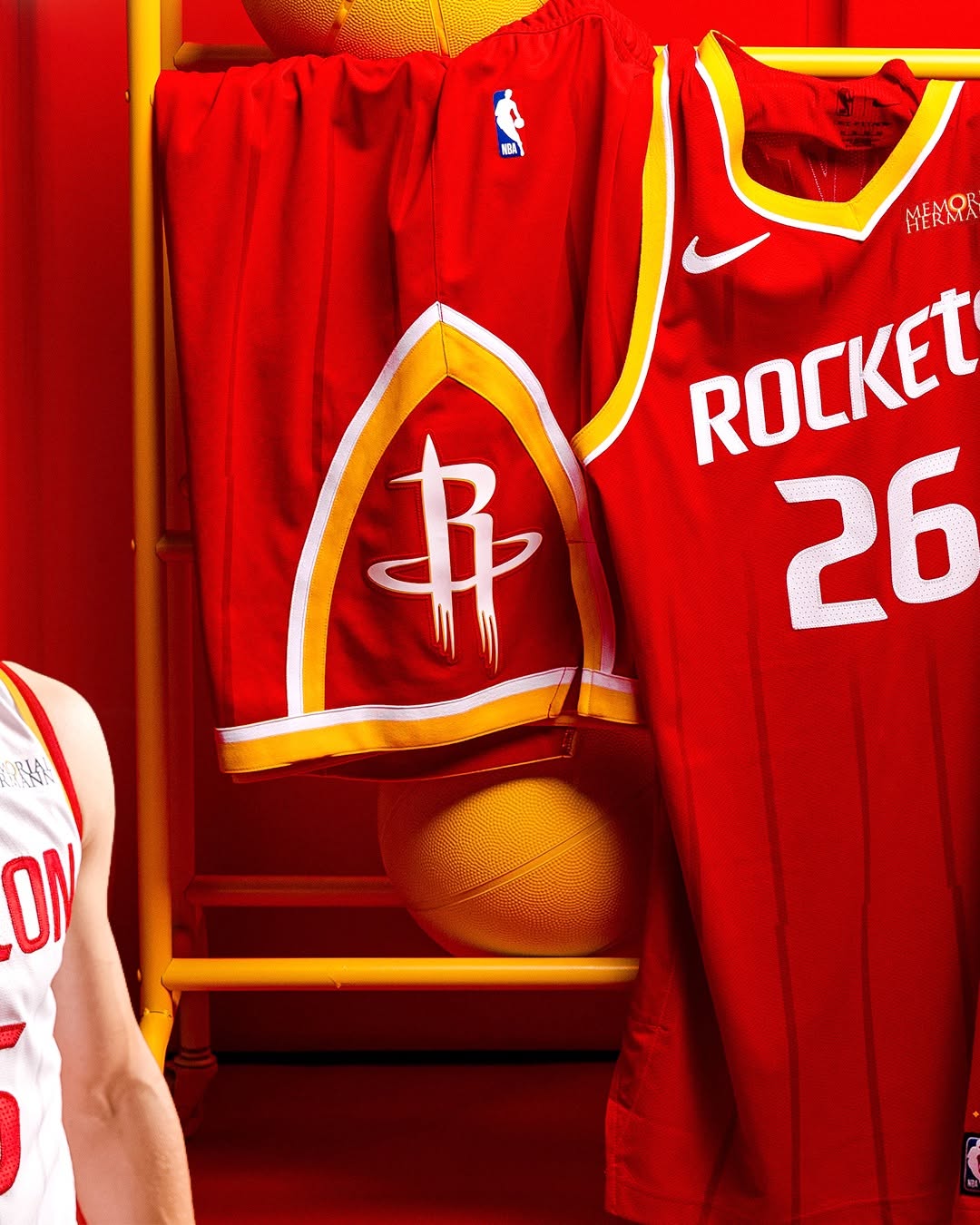
Houston’s Icon (red) and Association (white) uniforms for the 2026-27 season reimagine the franchise’s visual identity while honoring the eras that shaped Rockets basketball. The Icon Edition features “Rockets” across the chest, while the Association Edition showcases “Houston” as a tribute to the city.
Both uniforms are accented with broken tonal pinstripes inspired by the team’s look from the mid-1990s and early 2000s. Custom typography derived from the championship-era wordmarks, including the return of the signature lowercase “t” and a distinctive slanted presentation, completes a uniform system rooted in legacy and built for the future, according to the team.
The Statement jersey embraces Houston’s “Space City” identity and the relentless pursuit of innovation. Its black base symbolizes the vastness of space, while a quasar-inspired pinstripe reflects the team’s speed, force, and intensity.
Along the side panels, rockets rise seamlessly from the shorts into the jersey, thereby creating a continuous visual expression of momentum and acceleration. On the jersey’s back middle portion, a red commander’s stripe draws inspiration from NASA mission leadership identifiers.
Each jersey includes a “Clutch City” jock tag framed by two quasars. The shorts prominently feature the “R” logo, while the Dunkstronaut logo appears on the waistband.
Fans can purchase the new apparel at RocketsShop.com and sign up for a mailing list to be notified when jerseys are available for purchase.
To celebrate the launch, the Rockets are hosting a special retail pop-up event at Houston’s George R. Brown Convention Center. The pop-up event will take place outside of Hall D on Friday, June 5, from 10 a.m. to 8 p.m. local time.
The first 100 fans that spend $100 or more will receive a free T-shirt. Former Rockets Rudy Tomjanovich (noon-1 p.m.), Steve Francis (2-3 p.m.), and Vernon Maxwell (4-5 p.m.) will each hold a signing session. Fans can also enjoy a live DJ alongside an interactive photo booth, games, and complimentary food and beverage samplings.