
Houston Rockets
Houston Rockets Salary Cap Update: The New CBA
Well, after nearly five months of acrimony and bickering (not counting all the time prior to July 1, when the NBA owners locked out the players), it looks like the National Basketball Association is about to re-open for business.

Well, after nearly five months of acrimony and bickering (not counting all the time prior to July 1, when the NBA owners locked out the players), it looks like the National Basketball Association is about to re-open for business.
As team executives and coaches start officially communicating with players for the first time since June, they will be doing so under substantially different salary cap rules.
Since I have neither the time nor the inclination to detail all of the intricacies of the new collective bargaining agreement (CBA) and how it compares against the prior CBA, I will let salary cap guru Larry Coon do the explaining for me. If you have not yet read Larry Coon’s breakdown of the CBA changes, it really is a must-read. Also, it may be helpful to read that piece in order to fully understand some of the changes below in players’ cap figures, qualifying offers and contract sizes that can be offered to free agents.
Let’s begin.
Salary Commitments and Potential Cap Room
The Houston Rockets will have a minimum of approximately $46.81 million in salary commitments to eleven players for the 2011-12 season: Kevin Martin ($11.52 million), Luis Scola ($8.59 million), Kyle Lowry ($5.75 million), Hasheem Thabeet ($5.13 million), Jonny Flynn ($3.41 million), Jordan Hill ($2.86 million), Terrence Williams ($2.37 million), Courtney Lee ($2.23 million), Goran Dragic ($2.11 million), Patrick Patterson ($1.96 million) and Chase Budinger ($884,293).
Add to that amount the rookie scale cap holds of the recently-drafted Marcus Morris ($1.52 million) and Donatas Motiejunas ($1.13 million) (the new CBA has temporarily frozen first round rookie scale salaries at 2010-11 levels for similarly drafted players; second round picks like Chandler Parsons still do not count against the cap until signed); and each of Marcus Cousin and Marqus Blakely is set to earn $762,195 (under the new CBA, all league minimum salaries have been temporarily frozen at 2010-11 levels) if they manage to remain on the roster into next season. Chuck Hayes, the Rockets’ lone remaining (non-retired) free agent, will have a cap hold of about $3.75 million (the new CBA has reduced certain cap holds, resulting in a slight reduction in the Chuckwagon’s).
Based on this season’s salary cap figure ($58.044 million, at which the salary cap will be artificially set for this year and next before resetting based on the new BRI split), in order for the Rockets to maintain rights to all of its players, they will have approximately $3.31 million in salary cap room.
However, given that the compressed free agent signing period is expected to commence simultaneously with the opening of training camps, there will probably be some minor adjustments to this figure. While Motiejunas will continue to play in Poland this season, the Rockets will likely need to sign Morris and Parsons quickly in order to get them into training camp. Morris will command the typical 120% of his rookie scale salary (or $1.82 million, the same salary that Patterson got last season). Parsons is allegedly forcing his way into training camp by refusing to play overseas, meaning that the Rockets will need to either invite him to training camp (and offer him a contract) or release him outright; hence, Parsons will likely get either a minimum deal (for $473,604) or perhaps even a Budinger-like deal using a sliver of the Mid-Level Exception (for purposes of this piece, let’s assume he just gets the league minimum). Accounting for these timing issues, the Rockets’ cap room may be reduced to approximately $2.53 million.
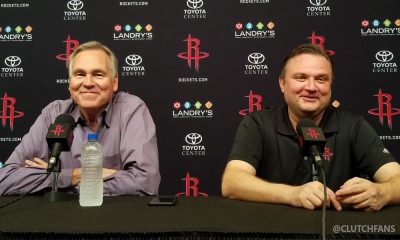
Daryl Morey and the Rockets currently face a tough decision regarding whether or not to re-sign Hayes. After a career year for the Chuckwagon (one in which the rest of the league finally took notice of Hayes’s ability to impact games on both ends of the floor), Hayes’s agent has already received several contract offers from other teams, including one from the Sacramento Kings (who play near Chuck’s hometown of Modesto). On the Rockets’ end, Morey must balance the value he places on Hayes (it is no secret that the Rockets value Chuck more than just about any other team would) against the Rockets’ desire for maximum salary cap flexibility going forward. A reasonable long-term deal for Hayes can still be worked out (it appears that Chuck is not interested in a one-year deal, even if the Rockets offer to make it a lucrative one); but the odds are against Morey re-signing him if his contract demands exceed a certain (relatively low) threshold.
Assuming that (1) none of the recently drafted rookies are waived (a likely bet), (2) Cousin and Blakely are waived (both contracts are fully non-guaranteed, except that Blakely’s deal becomes partially guaranteed for $25,000 if he’s on the roster at the start of the regular season), (3) Hayes’s rights are renounced (or Chuck signs with another team), and (4) no other trades or roster moves are made, then the Rockets’ cap room with the current roster (not playing overseas) all under contract would increase to approximately $7.8 million, subject to an additional increase should Morey elect to use the new “amnesty” provision on a current Rockets player.
2011 Free Agency . . . or “To Amnesty or Not to Amnesty”
With the aforementioned $7.8 million cap room figure, Morey would be able to keep the roster intact while offering a free agent a contract as large as a four-year, $33.34 million deal. However, that won’t be enough to nab one of the top free agents like Nene or Tyson Chandler.
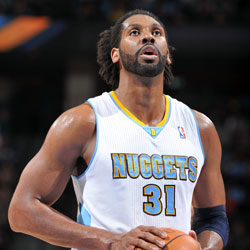
Nene would be a great addition to the Rockets, but at what price?
However, if a top free agent were truly willing to sign with the Rockets if the team could meet his demands, the Rockets could use the amnesty provision to waive Thabeet–allowing the team to wipe his salary off the books for cap and luxury tax purposes–and greatly increase their available cap room. (Of course, Les Alexander would still need to pay Thabeet every penny of the $5.13 million he is owed this season.)
If timed correctly, the Rockets could conceivably use the amnesty provision to waive Thabeet and, if combined with a delay in signing their rookies, could open up as much as $13.71 million in cap room and be able to offer a deal as large as four years, $58.54 million. These numbers could possibly increase even more with some minor trades to open up additional cap room.
While Morey appears to be capable of opening up enough cap room to at least legitimately contend for any top 2011 free agent, the odds are against him actually doing so. As Morey himself stated recently, he was unwilling to make a move that may help in the short term if it would ultimately hinder the franchise over the long term. Signing a very good–but not great–player to a near-max contract could potentially prevent the Rockets from being able to earnestly pursue a superstar in free agency or in trade.
I suppose that the Rockets could sign a major free agent to a sizable but moderately reasonable contract, either to keep for the long haul or to use in a later trade. Teams like Orlando (Dwight Howard) and New Orleans (Chris Paul) may be interested in a player like Nene if the Rockets were to include him in a package for such teams’ superstars.
When it’s all said and done, the likely result of the 2011 free agent frenzy will be that the Rockets make no significant additions via free agency. More likely, Morey will opt to preserve the team’s salary cap flexibility for 2012. In fact, I imagine that the Rockets will opt not to have any “cap room” at all.
By opting not to use cap room, the Rockets will instead preserve the use of (a) their Bird rights on Hayes (and on retired players like Yao Ming, Dikembe Mutombo and Warriors coach Mark Jackson), (b) the $5 million Mid-Level Exception, (c) the $1.9 million Biannual Exception and (d) existing trade exceptions (most notably, the $7.35 million trade exception generated in the Battier-Thabeet trade last February).
Given that the above rights and cap exceptions should give the Rockets more flexibility, my sense is that–unless Nene or Chandler are willing to come to Houston on a fairly reasonable contract–Morey will set his free agent sights towards 2012.
Amnesty Bargain Bin?: Risks & Rewards
Another potential avenue available to the Rockets for a roster upgrade may be through the “amnesty waiver wire.” Larry Coon has the details regarding the amnesty clause of the new CBA in his article referenced above. It is the waiver process resulting from casualties of the amnesty clause’s implementation that I will focus on here.
Once a player has been waived using the amnesty clause, he becomes subject to a modified waiver process. This process is only open to teams with available cap room (as opposed to over-the-cap teams with salary cap exceptions still available for use), avoiding the loophole of having good players–whose salaries are already being paid by other teams–signing for little money with over-the-cap contenders.
A team claiming any such player must still claim his entire contract; but rather than requiring that team to pick up the waived player’s entire salary, the claiming team may instead make a bid offering to pick up only a certain amount of the player’s salary. The under-the-cap team with the highest bid will be able to claim the waived player, and only the waiver bid claim amount of that player’s salary will count against the claiming team’s payroll and for salary cap and luxury tax purposes. The waiving team will then be partially relieved of the obligation to pay the waived player’s salary to the extent of the waiver bid amount.
As mentioned above, the Rockets may have a hard decision to make about whether to opt for use of their cap room or to maintain their salary cap and trade exceptions, especially if Hayes signs with another team. Assuming that the team did not opt to create cap room to sign any outside free agents for this season, if there is a player available on the amnesty waiver wire who can significantly help the Rockets, Morey might be willing to opt for cap room and make a waiver bid on that player.
But therein lies the risk. The details of the new CBA have not yet been reached on what happens to a team that makes certain moves to get under the salary cap (i.e., renouncing rights to free agents, waiving salary cap and trade exceptions, and possibly even amnesty waiving a player of its own) in order to place an amnesty waiver bid on a player but then gets outbid for that player by another under-the-cap team. Would the Rockets be left without all of the above, with no process by which to reclaim those players’ rights and cap exceptions? This will color any decision that Morey makes to pursue such waived players. And given Morey’s unwillingness to overpay, it is likely that another team will (perhaps foolishly?) outbid the Rockets on the amnesty waiver wire.
However, if it is any consolation, there are expected to be far fewer players actually waived this season via the amnesty clause than originally expected, with several teams either preferring to keep the amnesty in their pockets for a later date or (like the Washington Wizards with Rashard Lewis) needing to keep some high-salaried players on their books in order to meet the increased team minimum salary.
Trade As Most Likely Avenue for Improvement
Regardless, the most likely avenue by which Morey will look to improve the Rockets’ roster will be via trade. Rest assured that the Rockets will be among the many suitors for Howard, Paul and New Jersey Nets guard Deron Williams. While the Nets have no interest in trading Williams (for whom they recently gave up a veritable treasure trove of assets), there is increasing speculation that, due to some of the quirky new CBA rules, Orlando and New Orleans may actually entertain trades for their respective superstars as early as the next two weeks.

Dwight Howard, a potential free agent in 2012, could be one of the prizes of the 2011-12 trade season
Morey will be armed with the following (non-exhaustive list of) assets at his disposal:
–A shooting guard who finished in the top 10 in the league in scoring last season (Martin);
–A 25-year-old point guard who is great defensively, draws fouls and has continued to show marked improvement year to year (Lowry);
–A rock-solid veteran power forward who is an “NBA-young” 31 years old (Scola);
–Promising and highly regarded young talent (Lee, Dragic, Budinger, Patterson, Morris);
–Some “diamonds-in-the-rough” who can be obtained as throw-ins (Thabeet, Flynn, Hill, Williams, Parsons);
–New York’s 2012 first round pick (only top-5 protected), which is attractive despite the Knicks’ star duo because of the rare limited protection on the pick;
–Minnesota’s 2012 second round pick (which may be a high second round pick that proves more valuable than many late first rounders);
–Some nice young talent playing overseas (Motiejunas, Sergio Llull, Lior Eliyahu); and
–Some trade exceptions capable of absorbing extra “dead weight” salary from the other team (the Battier TPE being key here).
The Rockets’ pursuit of major trades should be helped by the new CBA’s relaxation of salary-matching rules for non-taxpaying teams (even though the Rockets paid a small amount of luxury tax last season, I don’t believe that will prevent them from benefiting under the new trade rules this season). Under the new CBA, teams with total salaries below the “luxury tax apron” threshold (approximately $74 million) can take back the lesser of (a) 150% of outgoing salary plus $100,000 or (b) 100% of outgoing salary plus $5 million. (Tax-paying teams are restricted to the prior limitations of 125% of outgoing salary plus $100,000.) Look for Houston to take full advantage off these new relaxed salary-matching restrictions, as payroll relief for the other team will be a key factor in the Rockets’ ability to acquire a star player via trade.
One trade asset that the Rockets will have less of this trade season is cash. Contrary to popular belief, Les Alexander has been among the NBA owners most willing to throw in cash in order to get a deal done. However, under the new CBA, teams may not include or receive more than $3 million in cash in trades in the aggregate during any season (the prior rule allowed teams to include up to $3 million in cash in each trade). Should an opportunity to acquire a supestar like Howard via trade present itself, the Rockets would be unable to break a larger deal into separate trades in order to pay more than $3 million in cash. Furthermore, assuming that the Rockets include most or all of their allotted $3 million in cash in one or more trades during or immediately after the 2011-12 season, Houston’s usual strategy of seeking out draft picks to purchase outright will be greatly hampered.
While Houston may not have quite the same caliber of assets that the Los Angeles Clippers sport (most notably, Eric Gordon and Minnesota’s unprotected 2012 first round pick), the Clips can only put ONE deal together that would clearly beat out anything the Rockets could offer. The Rockets should be able to compete with just about any other team in the race for a superstar via trade, due to the sheer quantity of attractive trade chips they possess. (Something that the media has failed to clarify about the Nets’ purported trade offer of Brook Lopez and two first round picks for Howard is that all of the Nets’ GOOD draft picks were already traded to Utah. The Nets only have the Rockets’ lottery-protected pick and the Nets’ own picks, none of which should be any good if the Nets successfully pair Williams with Howard.)
2012 Cap Situation
Given the many unknown variables that could change quickly once the league opens for business on December 9, it makes little sense even to speculate on where the Rockets might stand come July 1, 2012. That said, early indications are that Houston could have upwards of $22 million in cap room while still retaining Martin, Scola, Lowry, Patterson, Morris, Budinger and Motiejunas. (Of course, this figure would need to be reduced to account for Houston’s 2012 first round picks and any other players returning from this season’s roster.)
Moreover, if the opportunity presented itself to be able to add Howard AND either Paul or Williams next summer, there should be some opportunities to trade–or, if all else fails, to amnesty cut–a high-salaried player in order to add two superstars. That’s not a slam dunk by any stretch. Just a remote possibility.
Courtney Lee and The New Age of Restricted Free Agency
One key variable to 2012 cap room will be how the Rockets choose to handle Courtney Lee, who may be the current Rockets player most affected by the new CBA in the next year due to the player-friendly changes to restricted free agency.
If Lee is still on the roster by the end of next season, look for the Rockets to try hard to retain him. They’ll likely have plenty of competition for Lee’s services, however, as many teams hold Lee in high regard as a potential starting shooting guard.
Lee (much like Hayes this year) will have a lower cap hold next summer under the new CBA, with his cap figure being reduced from $6.6 million (under the old CBA) down to $5.5 million.
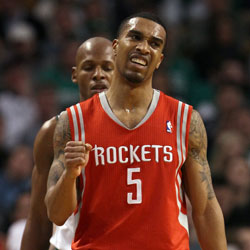
Courtney Lee may be the first Rocket affected by the changes in restricted free agency under the new CBA
If Lee’s market value increases high enough, the Rockets may be forced to choose between him and Martin; or they could try to convince a major free agent to take a slight pay cut in order to retain Lee (as Dwyane Wade, Lebron James and Chris Bosh did last year in order to allow the Miami Heat to re-sign Udonis Haslem).
Remember, even if Lee is worth, say, $9 million per year, the Rockets could keep him at his $5.5 million cap hold figure while signing a superstar, and then re-sign Lee to the higher figure afterward. Conversely, if Lee is only worth $4 million per year but the Rockets want to retain him, the Rockets would want to first sign Lee (thereby reducing his cap figure from $5.5 million down to $4 million or less) before signing any outside free agents.
How the Rockets approach whether to retain Lee in the face of a potentially stellar 2012 free agent class is further complicated by recent changes to how qualifying offers can be made to restricted free agents. Under the old CBA, teams could simply extend non-guaranteed qualifying offers in order to make a young player a restricted free agent, knowing that, if they later decided that they wanted to allocate that money elsewhere, they could simply unilaterally pull that offer off the table.
Not anymore. One of the bigger player victories in the CBA negotiations is that teams must now fully guarantee their qualifying offers.
What this means for the Rockets is that, if they want to retain Lee’s rights as a restricted free agent, they must occupy a portion of their cap room with Lee’s $5.5 million cap hold by making a guaranteed qualifying offer that cannot be taken off the books without Lee’s consent (unless he first signs a contract with Houston or another team).
If the Rockets do not make a qualifying offer to Lee (and thereby reduce their available cap room), then Lee will become an unrestricted free agent. Given the widespread interest in Lee, though, I’m not sure the Rockets want to risk losing him without at least having the opportunity to match any reasonable offer.
Another aspect of the new CBA is that certain young players who outperform their rookie deals will be entitled to larger qualifying offers. Players who average 41 starts or 2,000 minutes played in the last two years of their rookie deals will be entitled to (a) if the player is drafted in the first round but outside of the lottery, the qualifying offer available to the #9 pick from that draft and (b) if the player is not drafted in the first round, the qualifying offer available to the #21 pick from the player’s draft class.
Based on his production last season, if Lee starts in every game or plays heavy minutes this season (27.7 mpg if he plays in every game, with this threshold increasing for each game he misses), then his qualifying offer will presumably increase from $3.22 million (the offer available for his rookie scale slot) to $4.39 million (the offer available to the #9 pick in 2008).
Conclusion
While the Rockets have afforded themselves the flexibility to sign a major free agent in 2011 if needed, the likely outcome of the next month or so will be that the Rockets largely sit out free agency and either make an early trade or two for a talent upgrade or sit tight for a later trade or to pursue free agents in 2012.
There is no guarantee that the Rockets’ trade strategy will actually land them a superstar. But it puts them in as good a position as (almost) any other team to do so.
Flexibility is the key. And Morey has that in spades right now.
>> Comments
DISCLAIMER: Please note that all views expressed on the new CBA are solely based on that certain Summary of Principal Deal Terms dated November 26, 2011 and distributed to the media by the NBA (the “League Memo”). The League Memo is not a comprehensive collective bargaining agreement, does not address many key issues that may affect the new CBA and may be subject to change.















Pingback: Houston Rockets Salary Cap Update | Houston Rockets Blog | ClutchFans